How to manage project scope on a construction site: 6 tips for construction teams (2026)
6 proven strategies to control scope changes on construction sites. Capture variations with evidence, protect margin, and strengthen claims.


TL;DR
- Scope changes on site get agreed in conversation and buried in email, so variations never reach the record and margin leaks out through the gap.
- Managing project scope on a construction site is a control problem, not a planning one. Every change needs evidence, approval and an audit trail captured where it happens.
- Most standard contract forms put a clock on notification, from 8 weeks under NEC4 to 28 days under FIDIC. A change you haven't documented is a change you can't notify in time.
- The 6 tips below run end to end: scope baseline, lookaheads, change control, field capture, impact pricing and back-office integration.
Why scope management fails on construction sites (and what it costs you)
A site instruction gets agreed in a conversation by the hoarding. The subcontractor starts. Three weeks later the variation (a change order, in US contracts) is disputed, because nobody wrote it down, nobody approved it, and nobody photographed the conditions.
That gap is where margin goes. Change in scope is the top cause of claims and disputes across four major delivery methods – design-build, construction management, EPC and lump sum – according to HKA's 2025 CRUX Insight Report. The public megaprojects show the same mechanism at full scale. The Scottish Parliament at Holyrood was costed at around £40 million and settled at £414 million. Hamburg's Elbphilharmonie was tendered on an unfinished design against a €186.7 million budget and delivered at €866 million, seven years late. Neither inquiry blamed bad building. Both blamed change that nobody controlled.
Scope control on a live job runs across two desks: the site team who see the change first, and the commercial team who have to get paid for it. These 6 tips cover the handoff between them.
What is project scope management on a construction site? (and why generic PM advice doesn't work)
Project scope management on a construction site is how you define and control which work the contract includes and excludes, so every change gets captured, priced, approved and executed with a clear audit trail. It covers the scope documents that draw clear boundaries and the control processes that police them once work starts.
Generic advice falls down here. Work breakdown structures (WBS), scope statements and stakeholder sign-off assume a planning room and a stable set of project requirements. On a live job, scope lives in drawings, specifications, bills of quantities (BOQs), schedules of rates and, increasingly, the model itself. Teams running building information modeling (BIM) can point at a clash rather than argue about drawing revisions. Changes arrive during project execution, and the money sits in contract administration rather than the schedule.
So control runs on a cadence instead of a plan: lookaheads spot gaps, daily huddles confirm what's in scope today, RFIs (requests for information) clear ambiguity, field capture records variations, and monthly valuations turn them into money.
How to manage project scope on a construction site: 6 tips that work on live jobs
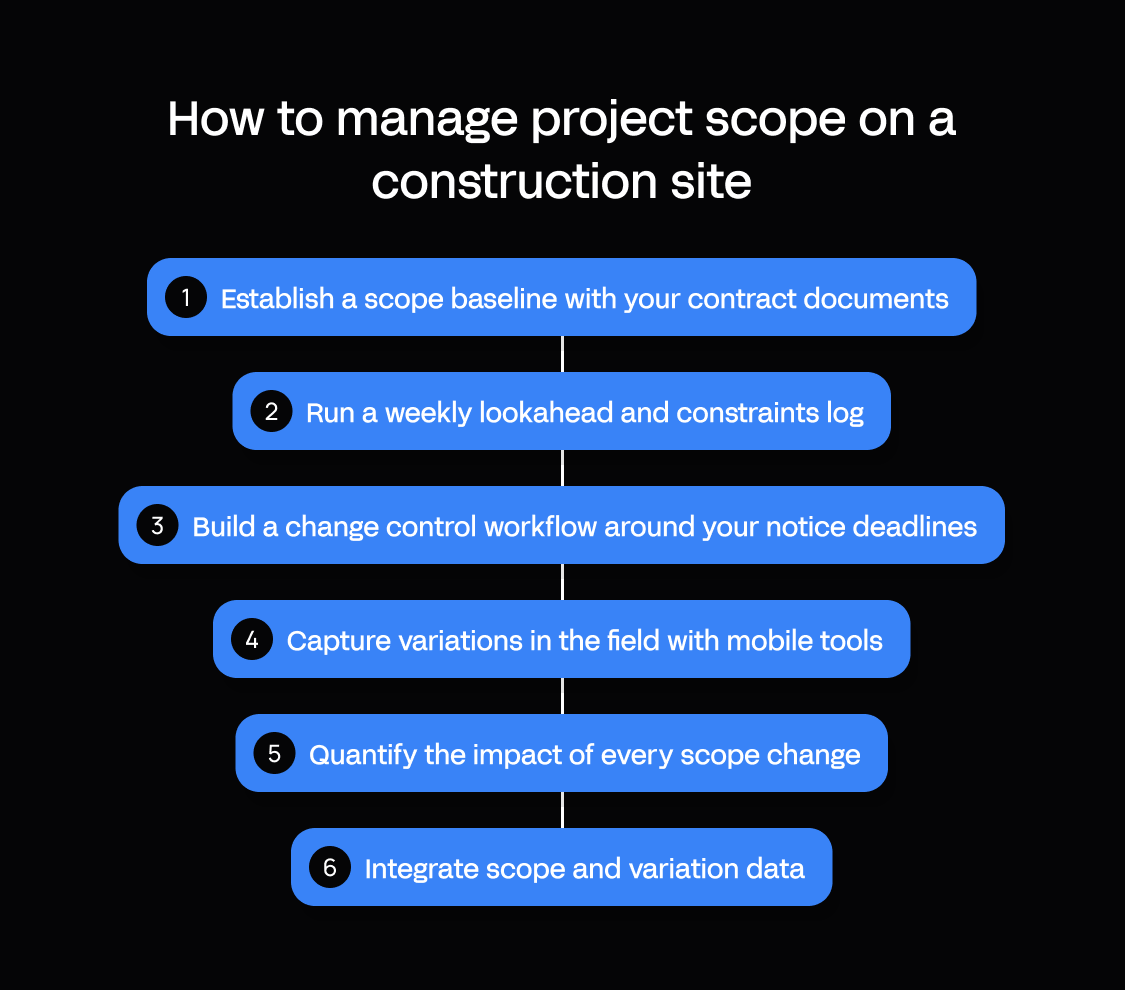
These run end to end. Baseline the scope at award, spot gaps before they land, control change with a workflow that respects your notice deadlines, capture variations with evidence, price their full impact, and close the loop with the back office.
1. Establish a scope baseline with your contract documents (before you mobilize)
What it is. The definitive record of what the contract includes: drawings, specifications, BOQs, a scope matrix by trade, and an inclusions and exclusions schedule, locked at award.
Why it matters. A scope baseline does for your commercials what a site datum does for your levels. Everything is measured from it. Let it drift and nothing looks wrong on site, but the numbers stop closing at final account and nobody can say when it started. With a firm baseline, defining project scope stops being a negotiation every time someone asks a question.
How to do it.
- Compile the scope package: issued-for-construction drawings with revision dates, specification sections by trade, and BOQs or schedules of rates.
- Build a scope matrix showing which trade does what at interfaces, such as fire-stopping, temporary power and builder's work in connection.
- Document exclusions and assumptions: client free-issue materials, access, utilities, provisional sums and allowances.
- Lock it somewhere version-controlled, then raid your past projects. Whatever went to dispute last time belongs in this job's exclusions schedule.
What good looks like. At the pre-start meeting, the site manager pulls up the baseline on a tablet, shows the subcontractor the drawing and spec section that define their scope of work, and settles the argument before anyone orders material.
2. Run a weekly lookahead and constraints log to spot scope gaps early
What it is. A weekly session, usually 3 to 6 weeks out, where the site team reviews upcoming work, logs constraints, and flags scope changes before they turn into crisis variations.
Why it matters. Most scope creep starts as a design gap, a missing detail, or a ground condition the contract never mentioned. Catch it early and you can raise an RFI and price the change while the subcontractor is still on last week's activity. Miss it and you get a verbal instruction, uncontrolled work, and a claim you'll still be arguing about at Christmas.
How to do it.
- Hold regular meetings with the site team, key subcontractors and, where you can get them, the design team.
- Walk the next 3 to 6 weeks activity by activity, asking whether the drawings and site conditions actually support the work.
- Keep a constraints log: description, impact on scope, cost and project timeline, owner, due date, status.
- Raise an RFI the moment a constraint could move the scope. Waiting always costs more than asking.
What good looks like. The site manager spots a missing structural detail three weeks out, raises an RFI, and prices the extra steelwork before the subcontractor mobilizes. The change is documented and priced before an hour of labor is spent.
3. Build a change control workflow around your notice deadlines
What it is. A documented route every change follows: RFI or site query, design clarification or instruction from the client's representative, priced variation proposal, approval, work, as-built record. The route is built around the notification deadlines in your contract, not around whoever happens to be free.
Why it matters. This is the part most teams get wrong, and it's expensive. An instruction you didn't record is an instruction you can't notify, and most standard forms put a clock on notification:
- NEC4: a compensation event must be notified within 8 weeks of the contractor becoming aware it happened. Miss it and the prices and the completion date don't change at all, however strong the claim.
- FIDIC 2017: 28 days from when you became aware, or should have become aware, as a condition precedent, with the detailed claim inside 84 days.
- JCT: no day count, but notice is required as soon as the likely effect becomes reasonably apparent. A 2024 Scottish decision, FES v HFD, treated that as a condition precedent, so "no fixed deadline" doesn't mean "no deadline."
- Norway's NS 8405 and NS 8407: uten ugrunnet opphold, without undue delay, and missing it forfeits the claim. The preclusion cuts both ways, though: if the employer stays silent on an irregular instruction, it's deemed a variation.
The periods differ, the principle doesn't. A claim notified late can be worth nothing on merits that would otherwise have won, and the only thing standing between you and a missed deadline is a record made on the day.
How to do it.
- Map your notice deadlines per contract at mobilization and build them into the workflow as due dates, not as folklore someone in the commercial team carries around.
- Assign responsibilities: who raises change requests, who issues instructions, who prices variations, who approves. Name people, not job families.
- Set authority thresholds so a site manager can lead on small values and larger changes route to the client automatically.
- Standardize the paperwork: one change request form, one variation proposal with cost and time breakdown, one signed approval record. If it isn't formally documented, it hasn't happened.
- Keep the two directions separate. A variation flowing down from the client's representative changes your scope and your entitlement. One you instruct to a subcontractor changes theirs and costs you money. Different forms, different thresholds, different registers, and the link between them is what you'll be asked to prove at final account.
One point is widely misunderstood and worth stating plainly: you generally can't refuse to build until the variation is priced and agreed. Under NEC4, FIDIC and JCT alike you comply with a valid instruction and claim afterwards, with narrow exceptions for health and safety, invalid instructions, and work so far outside the contract that it isn't a variation at all. The Norwegian NS forms are the outlier: you must perform disputed work, but you can demand security for the disputed amount and suspend if it isn't given. So the rule isn't "no work without an approved variation." It's that nothing starts until the instruction is recorded, and the price follows.
What good looks like. An instruction arrives Friday afternoon and is logged with photos the same day, which starts the notice clock cleanly. The commercial team prices it early the following week and the subcontractor proceeds against a variation reference. At final account, every change has a date, an instruction and an approval attached.
4. Capture variations in the field with mobile tools (photos, signatures, evidence)
What it is. Project teams using apps on the tablets and phones they already carry to document scope changes where they happen: photos, subcontractor and client-rep signatures, time stamps, location.
Why it matters. The best variation claim is worthless if you can't prove the work was instructed. Contemporaneous evidence is what survives a dispute, and it's what your notice depends on. Field operations live or die on capturing it offline. Skanska built Spreng, a tunnel-blasting app on Appfarm, for crews 7 km underground on an 11 billion NOK project (roughly €950 million) where nothing syncs until you drive out.
How to do it.
- Identify the capture points: daily site walks, pre-start meetings, variation instructions, inspections and hold points. A structured daily report covers half of these already.
- Standardize what you record per variation: description, reason, before-and-after photos, sketch, subcontractor estimate, time impact, approvals.
- Use an app that works offline and syncs later, with pre-built forms for common variation types and routing to the commercial team and client.
- Make capture a daily habit across the crew. Adoption is the whole game. When Nordic distributor Ahlsell rolled out its construction logistics apps, one site user set the bar: "It took about seven minutes, and then I understood how to use it."
What good looks like. The site manager walks the job each morning with a tablet, finds extra groundworks around unexpected services, photographs it, captures the subcontractor's estimate and submits the variation before lunch. Our roundup of construction apps covers the tooling options.
5. Quantify the impact of every scope change (cost, time, and productivity)
What it is. Pricing the full impact of every variation: direct cost, time impact on the schedule (the programme, in UK usage), productivity lost to disruption or rework, and indirect costs such as extended preliminaries.
Why it matters. It's easy to under-claim, because the direct work is the visible part and the wake it leaves isn't. A variation on the critical path earns an extension of time and prolongation costs. One that disrupts three other trades is a productivity claim. Price only the direct work and you absorb the increased costs and extended timelines yourself. That's how a project budget dies by a thousand small approvals.
How to do it.
- Price the direct cost: labor hours, materials, plant, subcontractor quotes.
- Assess the time impact. Does it hit the critical path, consume float, or justify an extension of time?
- Assess productivity and indirect impact: disruption to other trades, rework, extended site overheads, loss and expense.
- Link every variation to a schedule activity or cost code, and document the basis of every estimate. That documentation is your claim.
What good looks like. A variation adds blockwork. The commercial team prices the direct cost, identifies a critical-path delay, calculates the extended preliminaries, and submits the lot with full support. A quantified change is easier to approve than a vague one.
6. Integrate scope and variation data with your commercial and ERP systems
What it is. Connecting field capture to your back-office commercial systems (cost control, valuations, final accounts) and your ERP (enterprise resource planning), so changes move from site to office without re-keying.
Why it matters. Disconnected systems quietly change your project outcomes. A variation captured in the field but missing from the monthly valuation means you wait a full cycle to get paid for it, or don't get paid at all. Missing from cost control and you can't see actual against budget or the resources needed to finish. Missing from the ERP and your cash-flow forecast is fiction. Integration closes the loop.
How to do it.
- Map the data flow: field capture, pricing, approval, valuation, cost control, ERP.
- Connect by API to your commercial and cost systems (COINS, now Access Coins, Causeway, RIB CostX) and your ERP (SAP, Microsoft Dynamics 365, or Visma in the Nordics).
- Link your common data environment (Oracle Aconex, Dalux) so photos and instructions sit with the variation record rather than in someone's camera roll.
- Automate the handoffs, so an approved variation creates a valuation line without manual entry.
- Run a weekly review where the commercial team and site manager reconcile field variations against the current application for payment.
What good looks like. A variation approved on the 12th makes that month's application for payment rather than slipping a cycle, and cost control shows the updated forecast the same week. Everyone argues from the same numbers, which removes half the arguments.
How Appfarm fits: a custom scope and variation app
Off-the-shelf project management software is usually too rigid for your contract types and approval thresholds, or too slow to roll out across live jobs. Spreadsheets and email create no audit trail, don't work offline and don't talk to the back office. A custom app closes that gap: capture the change with evidence where it happens, route it for pricing, push the approved variation into your application for payment. You build it on Appfarm, one platform where you move between AI-assisted building and a visual canvas, and the apps it generates are PWAs (progressive web apps) that run in any phone or tablet browser, offline included, with nothing to install.
The honest trade-off is about ownership over time. A vibe-coded route gets you something fast, then hands your team a codebase to review, secure, patch and keep online. On a managed platform, your team owns what the app does and Appfarm owns keeping it running, and Appfarm essentially guarantees the app keeps working because it maintains the underlying technology. There's no exportable source code, so the theoretical lock-in is the same as any comparable hosted tool. What you're buying isn't the absence of lock-in, it's the absence of a maintenance burden.
Two things matter here in particular. Pricing is active-user based, so you pay for users who log in that month rather than per registered user or per app, which counts when half your users are subcontractors who open the app twice a quarter, and prices are public. And hosting is fully EU/EEA with ISO 27001 certification, which matters when the data is your commercial position on live contracts.
How it works. Describe the app in plain English with Appfarm AI – site managers log a change with photos, a cost estimate and a signature, then route it for approval. Appfarm generates a working app as transparent visual models you edit, so you can tune it to your contract types, notice deadlines and authority thresholds. It runs on Appfarm's managed cloud with role-based permissions, audit trails and offline capability, connects by API to your commercial system, ERP and common data environment, and extends from one site to the rest once it's proved. Operations leads the build; IT governs it, because sign-off on a production app holding contractual evidence sits with the IT team rather than whoever assembled it.
Proof. European contractors already run site operations on custom Appfarm apps. Norway's POB Entreprenør replaced whiteboards, Excel and PDFs with resource planning across up to 300 concurrent projects, built in under two weeks. Feiring, also Norwegian, runs production planning with mobile field reporting and quality control. Skanska's Spreng app handles tunnel blasting offline. None is a variation register, but all three are the same build: field capture, approval routing and a link back to the office. More on the Appfarm construction page.
Common scope management mistakes on construction sites (and how to avoid them)
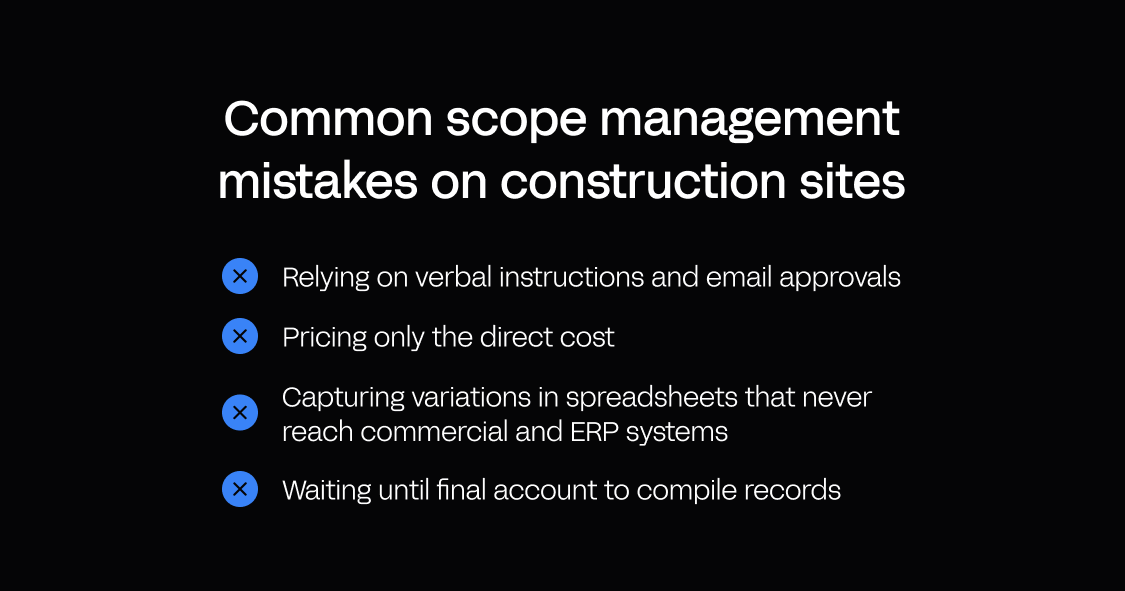
The failure is rarely the change itself. It's the four ways teams let it go unrecorded.
- Relying on verbal instructions and email approvals. No trail, no notice, no claim. Fix it with a change control workflow built around your notice deadlines (Tip 3) and field capture (Tip 4).
- Pricing only the direct cost. Ignoring time and productivity means under-claiming on every variation you raise, which compounds. Fix it by quantifying full impact (Tip 5).
- Capturing variations in spreadsheets that never reach commercial and ERP systems. Changes fall through the cracks and applications for payment come up short. Fix it by integrating the data (Tip 6).
- Waiting until final account to compile records. Missing documentation, faded memories, rejected claims, and notice deadlines that expired months ago. Fix it with capture at the point of change (Tip 4) and weekly lookaheads (Tip 2).
None of these mean a job is badly run. What separates firms is whether uncontrolled change gets caught within days or reconstructed after months.
Conclusion: Protect margin and strengthen claims by managing scope at the point it happens
Scope changes get agreed verbally and buried in email, so variations go unrecorded, notice deadlines pass, and margin leaves quietly. The 6 tips above turn scope control from a monthly reconciliation into a daily habit, from the baseline you lock at award through to the data you push into the valuation.
The clients who fund your projects rarely object to change itself. They object to hearing about it late, and so does your contract.
Ready to replace your spreadsheet-and-email variation process with an app built around your workflow? Get started for free and see what a first working version looks like.
FAQs about managing project scope on construction sites
How do you manage project scope?
Set a clear baseline, run a formal change control workflow (RFI, instruction, variation, approval) built around your contract's notice deadlines, capture every change with evidence in the field, quantify the full cost and time impact, and feed that data into your commercial and ERP systems. On site, that needs mobile tools and weekly routines.
What is a time bar in a construction contract?
A time bar is a deadline for notifying a claim, after which entitlement can be lost regardless of merit. NEC4 allows 8 weeks from the contractor becoming aware a compensation event happened. FIDIC 2017 allows 28 days as a condition precedent. JCT and the Norwegian NS forms use a "reasonably apparent" or "without undue delay" standard instead of a fixed count, and courts have treated those as binding too.
Who can instruct a variation on a construction site?
Only the person the contract names, usually the client's representative: the architect or contract administrator under JCT, the project manager under NEC, the engineer under FIDIC. An instruction from anyone else, including the client directly or a consultant on a site walk, may not be valid. Record who instructed what, and confirm irregular instructions in writing immediately.
What are the 5 C's in project management?
The "5 C's" is a mnemonic with no single standard definition, usually applied to project communication. One commonly cited version is clarity, conciseness, correctness, completeness and courtesy. For scope on site, the C that matters is control: without formal change control, scope creep erodes margin.
What is the 80/20 rule for project managers?
The 80/20 rule, or Pareto Principle, holds that roughly 80% of outcomes come from 20% of the effort. For construction managers it means concentrating on the few controls that prevent most margin leakage: a locked baseline, weekly lookaheads, and field capture before work proceeds.
What are the six steps of project scope management?
From the Project Management Institute's PMBOK Guide, 6th edition: plan scope management, collect requirements, define scope, create the WBS (work breakdown structure), validate scope and control scope. The 7th edition (2021) moved to a principles-based approach. On site, step six is where most firms fail, because they lack the field workflows to record and approve changes in time.
What is a scope baseline in construction?
The definitive record of what the contract includes: drawings, specifications, BOQs, a scope matrix by trade, and an inclusions and exclusions schedule. Locked at contract award, it is the reference point for every variation decision and makes it obvious when work sits outside the original scope.
How do you prevent scope creep on a construction site?
Project scope creep is uncontrolled expansion beyond the original objectives, so the cure is making expansion visible: lock a baseline, run weekly lookaheads, record every instruction before work starts, capture evidence in the field, and notify within your contract's deadline. Note that on most forms you must carry out a valid instruction and claim afterwards, rather than stopping work until the price is agreed.
What is the difference between a variation and a change order in construction?
Both mean a formal instruction to change the scope, with an adjustment to price or time. "Variation" is the term in UK and Commonwealth contracts such as JCT and NEC and in FIDIC; "change order" is the US equivalent. Norwegian NS 8405 and NS 8407 use endringsordre. Whatever it's called, it needs a written instruction, pricing and approval.
More reading

There are no items matching your filters. Please try another filter to view results.
We have a lot of helpful resources. Try another filter or reset the filters to find the resource for you.
Digital transformation without disruption