How to improve contract management: 13 proven tips for procurement teams (2026)
Discover 13 proven ways to improve contract management for procurement teams. Reduce risk, track obligations, and automate renewals with Appfarm.

TL;DR
- Centralize every contract in one searchable repository, tagged with supplier, value, renewal date, and owner, so any agreement is findable in seconds instead of buried in email threads and shared drives.
- Automate renewal reminders 90, 60, and 30 days before every expiry, so notice windows stop slipping and unwanted auto-renewals stop leaking budget.
- Enforce approval workflows with signature authority gates (value thresholds, legal review triggers, and finance sign-off), so nothing gets committed outside the process.
- Track obligations and milestones in a structured system with automated alerts, and score every contract against a risk taxonomy at intake so high-risk terms surface before signature.
- Appfarm is a platform for building a contract management app around your own sourcing process, and Appfarm or a partner can build the first version with you.
If you want to know how to improve contract management, start with where the work actually breaks. Most procurement, sourcing, and finance teams run contracts through email threads, shared drives, and spreadsheets. Renewals slip past unnoticed. Negotiated savings leak away. Someone spends an afternoon hunting for the current version of a supplier agreement.
This guide gives you a practical contract management strategy, organized by contract lifecycle stage, with 13 specific improvements you can operationalize. You will get concrete artifacts (an ownership matrix, approval gates, obligation tracking, and a short list of metrics) rather than vague advice to "communicate better."
We wrote it for operations-focused procurement and sourcing leaders at mid-market firms who own these broken processes and feel the daily cost. The goal is a clear path from manual, fragmented workflows to governed, centralized contract management, and from reactive firefighting to proactive management of every agreement.
What is contract management in procurement?

Contract management in procurement is the discipline of controlling supplier agreements across their full life, from sourcing through signature to renewal or exit. Done well, effective contract management protects negotiated value, keeps the organization compliant, and holds suppliers to what they agreed. It is how procurement turns a signed document into real commercial outcomes.
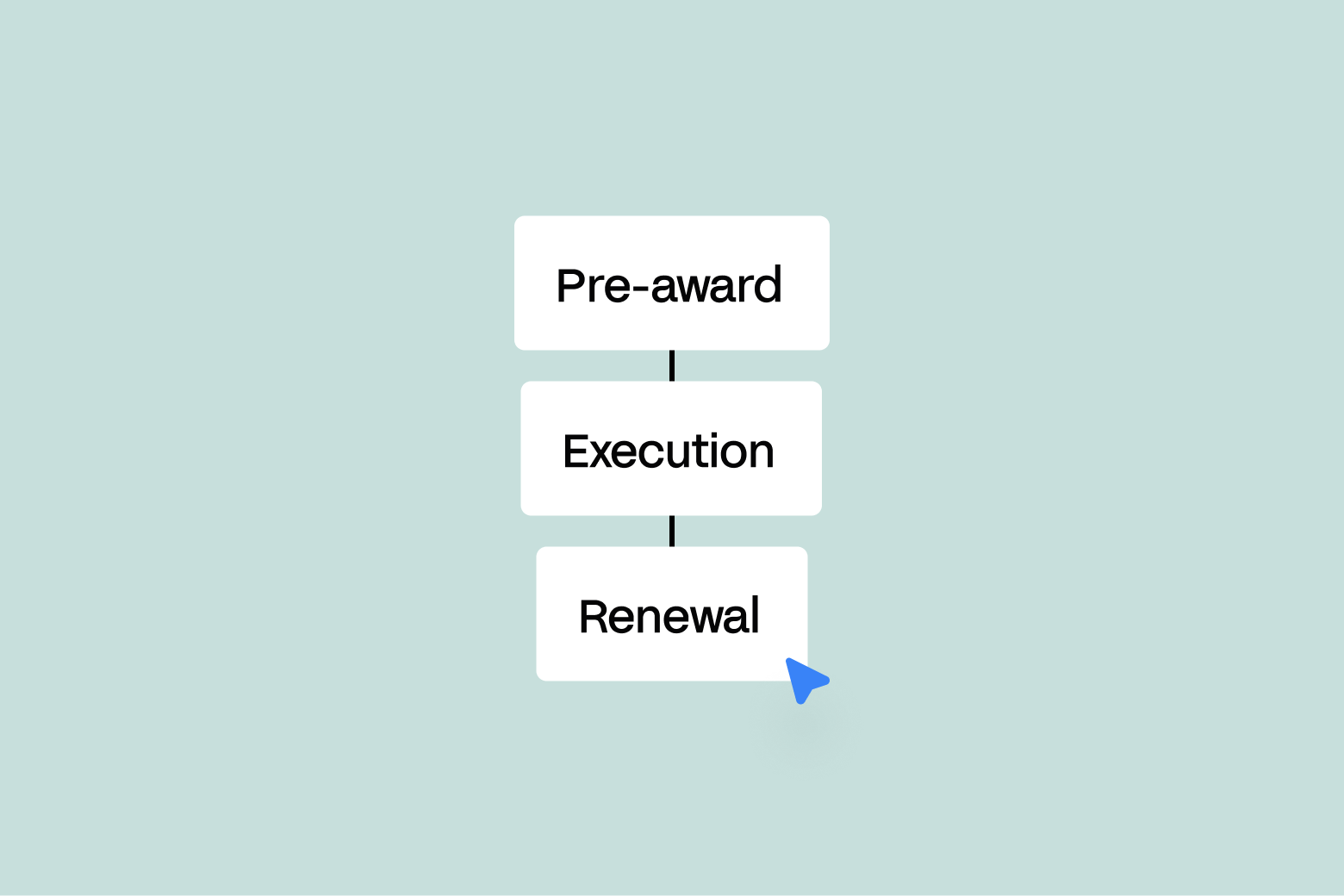
The work spans three lifecycle stages, and these are the key stages every procurement process has to govern. Contract lifecycle management (CLM) is the umbrella term for coordinating all three.
The pre-award stage covers sourcing, drafting, and negotiation. Teams assess supplier capability, standardize templates, agree terms, and route documents through approval before signing. Common documents here include a master service agreement (MSA), a statement of work (SoW), and a non-disclosure agreement (NDA).
Execution covers approval, signature, and handover into active management. This is where metadata, obligations, and ownership get recorded, or lost.
The post-award stage is where most value is won or leaked. It covers contract administration, obligation tracking, supplier performance, compliance monitoring, renewals, and eventual termination. Because the post-award stage runs for the entire lifecycle of the agreement, it demands the most consistent attention and the least manual effort.
How to improve contract management: 13 proven ways
Use these 13 improvements as a working checklist. They are grouped by lifecycle stage so you can fix the stage that hurts most first.
Pre-award: intake, drafting, and approval

1. Centralize contract intake with a single request form
Start every contract with one standardized intake form that captures supplier, contract type, value, business owner, urgency, and key terms. The form routes the request to the right stakeholders and creates a record from day one. This eliminates lost requests buried in inboxes, clarifies who owns each agreement before contract drafting begins, and gives you pipeline visibility into what is coming. When intake is structured, your team can prioritize by value and urgency instead of reacting to whoever emails loudest. A single front door is the cheapest control you can add, and it pays off at every later stage.
2. Use contract templates and clause libraries to speed drafting
Draft from a library of approved templates covering supplier agreements, NDAs, SoWs, and MSAs. Back them with a pre-approved clause bank for payment terms, liability caps, intellectual property (IP) ownership, dispute resolution mechanisms, and termination. Your negotiators stop reinventing language under deadline pressure, and legal reviews faster when most of a document is already cleared. Templates cut contract creation time, reduce errors, and keep terms consistent across every agreement your team signs. Mark which clauses are fixed and which are negotiable, and version the library so everyone drafts from the current language. Consistency at drafting is what makes downstream review and audit manageable.
3. Establish signature authority and approval workflows
Define who can sign what, based on value thresholds, contract type, and risk level. Route non-standard clauses to legal, require finance sign-off above a defined value threshold, and reserve executive approval for multi-year commitments. Documented gates remove the "who signs this?" delay that stalls sourcing, and they are how you maintain compliance on every high-value agreement.
Approval workflows are table stakes, offered by CLM tools and low-code platforms alike, so the real question is how you get governed workflows into production without a six-figure commitment. With the Appfarm Platform, teams build approval logic shaped around how their sourcing actually works. Pricing is public and active-user based, counting only the users who log in each month, so it scales attractively against fixed-price enterprise tools. Your team owns what the app does, and the platform owns keeping it running.
4. Track redlines and versions in one place (not email)
Keep every redline, comment, and version in one system instead of scattered email attachments. Label each clearly, such as draft v1, supplier redline, and final executed, so the current version is never in doubt. This ends the "which version is current?" scramble, speeds contract negotiations because everyone works from the same file, and creates a clean audit trail of who changed what and when. Lock superseded drafts so nobody negotiates against an old file by mistake. When the negotiation history lives in one place, handoffs between procurement, legal, and the business stop losing context.
5. Run a closing checklist before signature
Before anyone signs, run a short closing checklist so gaps get caught while they are still cheap to fix. Confirm all approvals are obtained, the terms match the approved version, exhibits and schedules are attached, insurance certificates are received where required, and the counterparty's signing authority is verified. Each of these is a common post-signature headache, and each is trivial to check beforehand. A signed contract with a missing schedule or an unverified signatory is a dispute waiting to happen. Make the checklist a required gate in your workflow, so it runs every time, on every contractual arrangement.
Execution and handoff

6. Distribute executed contracts to all stakeholders immediately
The moment a contract is signed, send the final executed version to everyone who needs it: procurement, legal, finance, the business owner, and the vendor manager. Do not let the signed file sit in one person's inbox. Store it in the central repository with clean metadata, including supplier, value, start and end dates, renewal terms, and owner. Immediate distribution means finance can pay against the right terms, legal has the definitive record, and the business owner knows what was actually committed. Capturing this contract information at handoff is what makes every later alert and report possible.
7. Centralize all contracts in a searchable repository
Every contract should live in one repository, tagged with metadata like supplier, contract type, value, renewal date, business owner, and key obligations. That makes any agreement findable in seconds, supports audits through reliable record keeping, and gives you a full view of commitments and spend across the organization. Scattered contract records are the root cause of missed renewals and off-contract spend.
Centralized storage is table stakes, offered by CLM tools and low-code platforms alike, so the real question is how you get there without a fixed six-figure commitment. Appfarm runs your repository as managed, production-grade software: EU/EEA hosting with data residency and ISO 27001 certification, backed by public, active-user pricing that counts only the users who log in each month. That scales attractively against fixed-price enterprise CLM. Food producer Baker Jørgensen used Appfarm partner Fortitude to pull work that had been scattered across several disconnected tools, including contracts and documentation, into a single application and a single source of truth within six months.
Post-award: monitoring, compliance, and performance

8. Track obligations and milestones with automated alerts
Track every obligation in a structured system rather than a spreadsheet: deliverables, service level agreements (SLAs), payment schedules, insurance renewals, and reporting deadlines. Obligations are the promises buried in a contract, and the ones you forget are the ones that cost you. Watch for scope creep too, where work drifts beyond the agreed statement of work without a change order. Set automated reminders 30, 14, and 7 days before each milestone, routed to the person accountable for it. A structured tracker with layered alerts turns obligation management from a memory test into a scheduled workflow, so suppliers are held to their commitments and your own deadlines never lapse silently. Measure the share of obligations met on time so you can see the trend.
9. Monitor supplier performance with KPIs and regular reviews
Define key performance indicators (KPIs) for each contract type: on-time delivery, quality standards, SLA compliance, and cost savings against baseline. Track these performance metrics monthly or quarterly so trends are visible before they become problems. Schedule quarterly business reviews (QBRs) with your material suppliers, using a standard agenda that covers performance against agreed metrics and performance expectations, open obligations, upcoming changes, and risk items. Share the numbers in advance so the meeting is a decision forum rather than a status update, and scale the attention to spend so your largest suppliers get the most. This is supplier relationship management in practice, and performance you measure is performance you can negotiate on at renewal.
10. Build a contract risk taxonomy and scoring model
Sort risk into a clear taxonomy so nothing hides. Legal risk covers liability, IP, and indemnity; financial risk covers payment terms, penalties, and foreign exchange (FX) exposure; operational risk covers single-source dependency and SLA gaps; compliance risk covers General Data Protection Regulation (GDPR) obligations, data residency, and audit rights. Score each contract low, medium, or high at intake and at renewal, then route high-risk agreements to legal and senior stakeholders and fast-track low-risk ones. Consistent scoring is what lets you manage risk deliberately instead of discovering it in a dispute.
Building a scoring model like this is where Appfarm AI helps. You start from an AI prompt describing the tracker you need and refine it on the visual canvas in the same platform, with no hand-off between tools. Appfarm uses third-party language models rather than a proprietary one, and refining on the canvas does not burn credits, so the app stays reviewable instead of a black box. The platform then runs it as managed software, with the same visual-development heritage that Norwegian refinancing firm Zen Finans used to replace a rigid, manual application process with a dynamic one, cutting build time by roughly half against traditional development.
11. Integrate contract data with ERP and finance systems
Connect your contract repository to your enterprise resource planning (ERP) and finance systems so agreed terms and actual spend stay aligned. Purchase orders match contract terms, invoices are validated against agreed rates, rebates are tracked and claimed rather than forgotten, and finance gets real-time visibility into committed spend. This is where contract management becomes real cost control. Flag currency exposure where FX terms apply.
Appfarm supports this through full API integrations into ERP and finance systems. ABB, for example, used Appfarm to build a customer ordering portal that syncs its full product library from its ERP system and enforces secure user roles, replacing manual, email-based ordering. For regulated procurement data, the foundation matters: EU/EEA hosting with data residency and ISO 27001 certification, single sign-on (SSO) for access control, and a managed lifecycle in which Appfarm reviews, secures, patches, and hosts the app. Your IT team stays accountable for approvals while carrying none of the raw-code maintenance burden.
Renewal and optimization

12. Automate renewal reminders and build a renewal calendar
Set automated reminders 90, 60, and 30 days before every contract expiry, routed to the accountable owner with enough lead time to act. Missed notice windows cost real money, through auto-renewals you did not want or lapses you did. Layered reminders turn renewal from a memory test into a scheduled decision. Build a renewal calendar with a monthly or quarterly view showing upcoming renewals, their value, and the decision owner, so nothing sneaks up on you and your largest agreements get a proper runway for renegotiation. A visible calendar prevents both missed deadlines and unwanted auto-renewals.
13. Conduct post-contract reviews to capture lessons learned
When a contract ends or comes up for renewal, run a brief retrospective before moving on. Ask whether it delivered the expected value, whether there were performance issues, whether the terms actually worked in practice, and what you would change next time. Capture the answers where they will be reused: feed better language back into the clause library and improved defaults into your templates. This closes the loop so continuous improvement is built into every contract cycle, instead of repeating the same mistakes with a new supplier. Make it a standard step at every renewal and exit.
How to reduce risk in contract management
Risk in contract management falls into four categories, and each needs a named owner rather than shared anxiety.
Financial and commercial risk covers value leakage, unclaimed service credits, unfavorable auto-renewals, and currency exposure. Legal and compliance risk covers regulatory breaches, including GDPR obligations, and unenforceable or missing clauses such as weak dispute resolution mechanisms. Operational and performance risk covers suppliers who miss service commitments or deliver late, and depends in part on the financial stability of the supplier behind the contract. Security and data risk covers who can access supplier and contract data, and where that data is stored.
Assign each category with a RACI matrix (responsible, accountable, consulted, informed). Procurement is typically responsible for commercial terms and supplier performance, legal is consulted on clause risk, finance is informed of value exposure, and the IT team or IT director is accountable for any contract system that runs in production. That IT ownership matters: the person who signs off on a production app carries its security and compliance risk. Meeting regulatory requirements is a shared duty, but accountability has to sit with a named role.
Tooling reduces risk when it is governed rather than improvised. Handling supplier and contract data on EU/EEA-hosted, ISO 27001-certified infrastructure keeps residency and access controls consistent, and a managed platform that patches and secures the app removes a class of risk your team would otherwise carry alone.
How Appfarm improves contract management for mid-market procurement teams
Mid-market procurement teams are stuck between two bad options: a six-figure enterprise CLM commitment that overshoots their needs, or custom development that leaves them maintaining code they cannot support. Appfarm is a third path.
With the Appfarm Platform, you build a contract management app shaped around your actual sourcing workflow, then run it as governed, production-grade software. Pricing is public and active-user based, counting only the users who log in during a given month, so a team pays the same whether 50 or 100 of its included users sign in, and it scales attractively against fixed-price enterprise tools.
Building the app is one fluid workflow. You start from a prompt in Appfarm AI that generates a working app, then refine it on the visual canvas in the same platform: metadata fields, approval rules, notification triggers, and integrations. You move back and forth as often as you like, and refining on the canvas does not burn credits. Appfarm uses third-party language models rather than a proprietary one, and its visual development heritage sets it apart from pure AI app generation.
The lead advantage is managed lifecycle ownership. Your team owns what the app does; the platform owns keeping it running, including reviews, security patching, hosting, uptime, and disaster recovery. You are not handed a codebase to maintain, which is the trap of the raw-code route. And nothing beats putting the app in front of real users to surface the workflow gaps a spec never catches.
Getting that app into production and keeping it there is the point. Appfarm hosts everything in the EU/EEA with data residency and ISO 27001 certification, and role-based access with single sign-on (SSO) governs who can read and change contract data.
Appfarm is honest about lock-in: there is no code export, and it carries the same theoretical lock-in as comparable hosted tools. The value is the business logic your team codifies while building, and the larger risk is staying in spreadsheets. On the free tier, apps are uncounted, and roughly 400 credits is enough to build one app. See the customer stories hub for documented operational transformations, from Luxembourg food producer Cocottes, whose partner-built no-code system replaced fax-and-manual production and supply workflows with an ERP-grade platform, to ABB's ERP-integrated ordering portal.
Contract management KPIs to track improvement

Measure a focused set of KPIs so you can prove the process is genuinely improving. Review them each quarter and tie each to an owner.
- Contract cycle time: average days from request to signature. Falling cycle time means your templates and approval gates are working.
- Approval cycle time: average time a contract spends waiting in approval. A spike points to an unclear or overloaded gate.
- Renewal capture rate: share of intended renewals actioned before the notice window closes. This directly protects value.
- Auto-renewal miss rate: contracts that renewed automatically without a deliberate decision. Drive this toward zero.
- Obligation compliance rate: share of tracked obligations met on time, by you and by suppliers.
- SLA compliance and service credits claimed: performance against agreed thresholds, and the credits you actually recovered.
- Value leakage vs. savings realized: negotiated savings that reached the bottom line against what slipped away.
- Repository coverage: share of active contracts held in your central system rather than in email or drives.
Conclusion: from spreadsheets to governed contract management
Improving contract management is not one heroic project. It is a set of specific, stage-by-stage habits: standardize before you sign, capture clean data at signature, and protect value across the post-award life of every agreement. Assign clear ownership, automate the reminders humans forget, and measure a handful of metrics so you know it is working. That shift, from reactive scramble to proactive management, is what turns a pile of contracts into predictable commercial outcomes.
The teams that make the leap move from scattered spreadsheets to a governed system they actually trust. Appfarm gives mid-market procurement teams governed contract management on a managed, EU/EEA-hosted platform with public, active-user pricing, where your team owns what the app does and Appfarm owns keeping it running. On Appfarm's free tier, apps are uncounted, and roughly 400 credits is enough to build and deploy your first contract app.
Frequently asked questions
What are the 5 steps of contract management?
The five steps are: (1) request and intake, capturing the need on a standard form; (2) drafting and negotiation, working from approved templates; (3) internal review and approval through defined gates; (4) execution and distribution to all stakeholders; and (5) post-award monitoring, covering obligation tracking, performance, and renewal or termination.
What are the 7 rules of a contract?
The seven rules are the essential elements of a legally binding contract: (1) offer, (2) acceptance, (3) consideration, (4) mutual intent to be bound, (5) legal capacity, (6) lawful purpose, and (7) certainty of terms. Without all seven, an agreement may not be enforceable.
What are the best practices for contract management?
Centralize contracts in a searchable repository, automate renewal reminders, and enforce approval workflows with signature authority gates. Track obligations and milestones with automated alerts, monitor supplier performance with KPIs, integrate with ERP and finance systems, and conduct post-contract reviews. Consistent habits beat one-off cleanups.
What skills do you need for contract management?
Contract managers need negotiation, attention to detail, and a working understanding of legal and commercial terms. Add stakeholder management, risk assessment, and process design, plus familiarity with contract management software and workflow automation. The strongest practitioners pair commercial judgment with the discipline to keep a process running consistently.
How do you reduce risk in contract management?
Build a risk taxonomy across legal, financial, operational, and compliance categories, then score every contract at intake. Route high-risk agreements to legal and senior approvers, track compliance obligations with automated alerts, maintain approved clause libraries, and review risk KPIs quarterly. Surfacing potential risks before signature beats managing a dispute afterward.
What is contract lifecycle management (CLM)?
Contract lifecycle management (CLM) is the end-to-end process and tooling for managing contracts across the entire lifecycle, from request through renewal or termination: intake, drafting, negotiation, approval, execution, obligation tracking, performance monitoring, and renewal. It is ideally supported by a central repository and workflow automation that keep every stage governed and visible.
What KPIs should you track for contract management?
Track contract cycle time, renewal capture rate, and obligation compliance rate to see whether the process is improving. Add approval bottleneck time, spend leakage, risk coverage, and repository completeness for a fuller picture. Review the set each quarter and tie every metric to an owner who can act on it.
More reading


There are no items matching your filters. Please try another filter to view results.
We have a lot of helpful resources. Try another filter or reset the filters to find the resource for you.
Digital transformation without disruption