How to improve fleet management: 7 proven tips for logistics teams (2026)
How to improve fleet management: 7 tips for logistics teams to cut fuel costs, prevent downtime and stay audit-ready with one live view of your fleet.


Key takeaways
- Improving fleet management starts with one live record of vehicles, drivers, defects, maintenance, fuel and compliance.
- The quickest wins are digital walkaround checks linked to repairs, mileage-based preventive maintenance and fuel managed by exception.
- Track five numbers: cost per mile, unplanned downtime, defect-to-repair time, fuel spend per vehicle and compliance items overdue.
- A live compliance view keeps you ready for any audit or roadside check, such as a Driver and Vehicle Standards Agency (DVSA) visit.
- Buy standard fleet software for standard needs. Build around your workflows where they don't fit the box.
Walkaround sheets pile up in the cab. The preventive maintenance inspection (PMI) schedule lives in one spreadsheet, fuel card data in another and driving license checks in a third.
Then UK diesel hit a record 200.01p per liter on 2 October 2026, according to RAC Fuel Watch, beating the June 2022 high of 199.09p. By 9 October, it had slipped only just back under £2 a liter.
Cost and downtime rarely spike. They creep, and you find the missed PMI at a roadside check.
This guide shows you how to improve fleet management in seven steps, ordered by payback. You also get a key performance indicator (KPI) set and a scorecard for choosing systems. The examples use UK rules and prices, but the steps work for any fleet.
Why fleet management stalls on spreadsheets
Fleet management stalls when inspections, maintenance, fuel and compliance live in separate records, because nobody sees the connections until they cost money. Most fleets already collect plenty of data. It just never connects.
- A defect ticked on a paper walkaround sheet never becomes a work order.
- A fuel card transaction never gets compared against the vehicle's route.
- A truck's rising fuel consumption never gets linked to the overdue service on the same vehicle.
- Since 2 February 2026, DVSA emails PG10 notices, which confirm a prohibition on a vehicle has been cleared. They go to the email address on your operator account, so one sent to an ex-employee's inbox goes unread.
At a DVSA visit, what counts is whether your records are complete and current, and how quickly you can produce them. The fix is turning scattered records that lag behind into one live view you can act on.
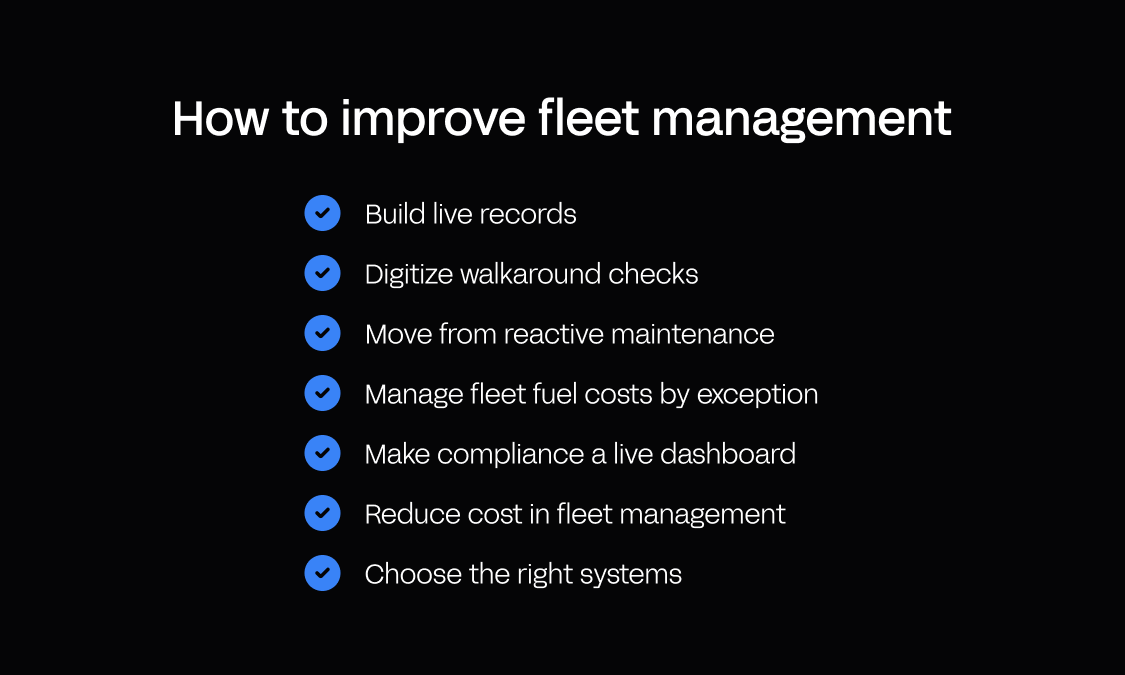
How to improve fleet management in 7 steps
The steps are ordered by payback: data first, then the daily loop, then cost levers, then systems. Start with step 1, because every later step uses it.
1. Build one live record for every vehicle and driver
Give every vehicle and driver one live record, linked to their defects, work orders, fuel and compliance items.
What to do
Create six linked records:
- vehicles, with registration, type, MOT (annual roadworthiness test) and PMI dates, and mileage
- drivers, with license category, Driver Certificate of Professional Competence (Driver CPC) and check dates
- defects
- work orders
- fuel transactions
- compliance items
A defect then belongs to a vehicle and a driver, and opens a work order. Clean the spreadsheet you trust most and make it your starting data.
What it fixes: records nobody can join up when a decision is due.
2. Digitize walkaround checks and close the defect-to-repair loop
Move walkaround checks onto phones and link every failed item to a repair. The walkaround is your fleet's most frequent workflow, so it pays back fastest.
What to do
Good practice for heavy goods vehicles (HGVs) and vans:
- The driver completes the check on a phone, with photos.
- A failed item raises a defect automatically.
- The defect goes to the workshop or an approved repairer, with a status.
- A safety-critical defect takes the vehicle off the road.
- Defect and repair records stay retrievable for at least 15 months, per DVSA's Guide to maintaining roadworthiness.
Drivers do checks in the cold with gloves on, and yards often lose signal. Look for apps that capture offline, sync when the signal returns and accept voice dictation for defect notes. Bertel O. Steen handles around 30,000 vehicle inspections a year on a custom app linked to its enterprise resource planning (ERP) system.
What it fixes: defects ticked on paper that never become work orders.
3. Move from reactive to preventive maintenance
Preventive maintenance (often called preventative maintenance in the UK) means scheduling work from real mileage, usage and MOT results, so vehicles come off the road when you choose, not after an unexpected breakdown.
What to do
- Schedule PMIs at the intervals you declared on your operator license (O-license), by date and mileage.
- Set service schedules by type of work as well as distance. A van on multi-drop city routes takes more brake and tire wear and tear than one on motorway runs at the same mileage.
- Feed vehicle data from telematics, such as engine fault codes and actual mileage, into the vehicle record, so a warning raises a work order before it turns into a breakdown.
- Stagger MOT dates to spread workshop load.
- Treat MOT advisories as next month's work orders.
- Pull MOT data from DVSA's MOT history application programming interface (API) instead of retyping it.
- Link each vehicle's unplanned downtime to lost jobs or hire costs. That shows you where preventive work will reduce downtime the most.
Updated DVSA HGV and public service vehicle (PSV) inspection manuals apply from 1 April 2026, so check your PMI sheet against them.
What it fixes: the missed PMI you only discover at a roadside check, and the costly downtime of a breakdown mid-route.
4. Manage fleet fuel costs by exception
The answer to how to manage fleet fuel costs is to work from live exceptions instead of monthly averages. With diesel around £2 a liter, small leaks add up fast.
What to do
Worked example (assumptions): one 40-tonne articulated HGV, 8 miles per gallon (MPG), 100,000 miles a year, 50 trucks.
That truck burns 12,500 gallons, or about 56,800 liters, a year. Every 1p per liter costs about £568 per truck, or about £28,400 across 50 trucks. Then work the levers:
- fuel card rules that limit product, volume, time and location
- card transactions reconciled against telematics location and mileage, so fuel usage that doesn't match distance driven stands out
- flags for liters filled above tank capacity, a theft signal
- MPG per vehicle and driver, compared with peer vehicles on similar routes
- an idling policy backed by telematics idle time data
- tire pressure and maintenance, since under-inflated tires and overdue servicing both lead to increased fuel consumption
- route planning that cuts empty and out-of-route miles, with route variance tracked against plan
Driving habits are one of the biggest fuel levers you control. Harsh acceleration, heavy braking and speeding all push fuel consumption up, and most telematics systems already score them. Compare driver performance with peers on similar routes, and use it for coaching rather than blame. A driver whose MPG fell after a route change needs a different conversation from one whose harsh-braking events have doubled. Where a pattern of aggressive driving continues, offer further training and share the results when they improve.
On the example truck, a 5% gain in fuel efficiency saves about 2,840 liters a year. At £2 a liter, that's roughly £5,700 per truck, or about £284,000 across 50 trucks.
UK MPG uses imperial gallons (4.546 liters). A live exception list shows the three vehicles and two cards that need a conversation this week.
What it fixes: the fuel spike you only see on the month-end card statement.
5. Make compliance a live dashboard
A live compliance dashboard shows what's due and overdue across the entire fleet, so you're ready for DVSA on any day.
What to do
For UK HGV and van fleets, track:
- O-license undertakings on maintenance, drivers and records
- your Operator Compliance Risk Score (OCRS)
- tachograph and drivers' hours records
- driving license checks with the Driver and Vehicle Licensing Agency (DVLA), plus Driver CPC
- MOT, tax and insurance dates
- PG10 notices and prohibition clearance
Give each item an owner, a due date and an escalation rule. Show overdue items in a red, amber and green view. Send PG10 emails to a role inbox, such as the transport manager's, and keep that address current on your operator account.
Digital records also support DVSA Earned Recognition, a voluntary scheme for operators who have held an O-license for at least two years. Members use driver and vehicle maintenance systems that report performance measures, share that data with DVSA and are less likely to be stopped for inspections.
If you run trucks: the daily essentials
- walkaround check before leaving the yard
- defects reported with photos
- tachograph downloads on schedule
- PMI calendar checked weekly
- DVLA driving license and Driver CPC checks
What it fixes: the scramble to rebuild records before a DVSA visit.
6. Reduce cost in fleet management with utilization and lifecycle data
Knowing how to reduce cost in fleet management starts with two things: cost per mile by vehicle, which rolls fuel, maintenance and other operating costs into one number, and how often each vehicle works.
What to do
- Find vehicles parked more than they run. Each one still carries insurance, tax and depreciation.
- Right-size the fleet from that data.
- Plan replacements from whole-life cost as well as age. Total cost covers the purchase price, fuel, maintenance, downtime and resale value, so the cheapest vehicle to buy isn't always the most cost-effective to run.
- Standardize vehicle specs. Shared parts, tools and training bring long-term savings in the workshop.
- Compare leasing and ownership costs.
- Check electric vehicle (EV) suitability by route profile.
Take these KPIs into your next budget review:
| KPI | What it tells you | Where the data usually lives today | Review cadence |
|---|---|---|---|
| Cost per mile | True running cost by vehicle | Spreadsheet + fuel card + workshop invoices | Monthly |
| Unplanned downtime | Lost capacity and hire costs | Workshop notes, dispatch whiteboard | Weekly |
| Defect-to-repair time | How fast safety issues close | Paper sheets, email | Weekly |
| Fuel spend per vehicle | Consumption and misuse | Fuel card statement | Weekly |
| Compliance items overdue | Audit and O-license risk | Multiple spreadsheets, inboxes | Daily |
| Utilization rate | Right-sizing opportunities | Telematics portal | Monthly |
Read these key metrics together, not one at a time. When a vehicle's cost per mile and unplanned downtime climb at the same time, it often costs more to keep than to replace.
What it fixes: cost that creeps because nobody sees it vehicle by vehicle.
7. Choose systems that fit how your fleet actually works
The right fleet system matches how your fleet works, so test every option against your real workflows.
What to do
- A telematics or fleet management software suite suits a uniform fleet whose tracking, driver behavior and maintenance needs are standard.
- Spreadsheets are fine for a handful of vehicles.
- A custom operational app suits workflows or mixed assets that don't fit the box, or several systems you need in one view.
If your fleet is small and standard, buy the suite. Build where it matters. Many fleets end up with telematics for tracking and a custom workflow layer on top.
Weight each criterion from 1 (nice to have) to 3 (must have).
| Criterion | Why it matters | Questions to ask the vendor | Weight (1–3) |
|---|---|---|---|
| Offline capture | Yards and rural routes lose signal | Does the app save checks offline and sync later? | 3 |
| Voice input and dictation | Gloves, cold and cabs make typing slow | Can drivers dictate defect notes and check answers? | 3 |
| Photo and evidence capture | Photos settle disputes and guide repairs | Are photos time-stamped and linked to the defect? | 3 |
| Defect-to-repair workflow | Your approval rules are your own | Can we change routing and approvals ourselves? | 3 |
| Integrations | Telematics, fuel card, DVSA MOT and ERP or accounting data must flow in | Which APIs are supported, and who builds connections? | 3 |
| Compliance dashboards and record export | DVSA visits need records produced on request | Can we export every record per vehicle? | 3 |
| Role-based access | Drivers, workshop, transport manager and subcontractors need different views | Can we set permissions per role and depot? | 2 |
| Mixed assets | Trailers and plant need records too | Can one system hold vehicles, trailers and plant? | 2 |
| Cost model at your driver headcount | Per-seat pricing hurts large driver bases | Do we pay for registered users or only active ones? | 2 |
| Maintenance after go-live | Your process will change | Who updates the system when it does? | 2 |
Assessing fleet systems for construction fleets
Construction companies run HGVs, vans and plant across changing jobsites. If you're working out how to assess fleet management systems for construction tech, add these criteria:
- job and cost-code allocation for vehicle and plant costs
- jobsite geofences
- plant hours as well as mileage
- access for subcontractors and hired-in vehicles
- rugged devices and offline use on site
- support for Earned Recognition, the Fleet Operator Recognition Scheme (FORS) and Construction Logistics and Community Safety (CLOCS)
See how construction teams run fleet and site operations on Appfarm.
What it fixes: buying a system your fleet has to work around.
Rollout and change management: getting drivers and workshops on board
Drivers adopt a new app when it beats paper and their reports get fixed. Success depends on change management more than on the software.
Start with one workflow at one depot, usually walkaround checks. Pilot with 5–10 drivers, and include your biggest skeptic.
Design for the cab, with few taps on large buttons and offline capture by default. Add photo and voice input for defect notes. The digital check should take less time than the paper one.
Close the loop where drivers can see it. When drivers see a reported defect fixed, they report more. Share short "you reported it, we fixed it" updates.
Train in toolbox talks at the depot, and name a depot champion who answers questions on shift. Run paper in parallel for two to four weeks, then retire it on a set date.
Measure adoption by checks completed digitally and defects logged with photos. Logins alone tell you little. Ask pilot drivers what slowed them down, and fix it before the next depot.
Then expand in stages:
- Replace the walkaround spreadsheet in week 1.
- Connect maintenance and fuel data in month 1.
- Run live compliance dashboards by month 3.
- Scale across depots by year 1.

How Appfarm handles fleet management
Appfarm is a platform for building custom operational software, and a fleet management app is a common one for logistics teams. You decide what the app does: the walkaround checks, defect forms, approval rules, compliance items and KPIs. Appfarm runs everything underneath it: deployment, hosting, security, performance and availability.
You don't have to build it yourself. Most teams start by working with Appfarm or an implementation partner to scope and build the first version, then take building in-house later if they want to. Other teams start building directly.
A fleet app doesn't have to be the only thing you get out of it. Driver onboarding with license and CPC tracking, a haulier portal or dispatch and resource planning can run on the same foundation instead of becoming more subscriptions. Pricing is tiered and active-user based: only people who log in in a given month count, and Appfarm's prices are public. As of October 2026, the Essential plan is €2,350 a month and includes five apps and 100 active users, so your fleet app and the next ones you build share one plan.
You build the app instead of adopting a fleet vendor's template, so it fits how your depots actually run rather than forcing drivers and workshops around fixed forms. Describe what you need, and Appfarm generates a working app. Then adjust it by moving its building blocks, by prompting again, or both at once: the walkaround questions for each vehicle type, who a safety-critical defect routes to, when a vehicle comes off the road. Visual building is where Appfarm started, so every part of the app stays something you can see and change. When a PMI interval or a reporting rule changes, you change the app to match.
Appfarm connects to any service with a standard API, so telematics, fuel card, ERP and accounting data can flow into the same records, and scheduled jobs can handle work like overnight fuel reconciliation. GPS tracking and dashcam video stay with your telematics provider; Appfarm brings that data into your workflows. The apps work across devices, can be installed on a phone or tablet and update automatically, and field operations apps keep working offline and sync when the signal returns.
Appfarm runs on Google Cloud in Belgium and is ISO 27001 certified, with GDPR-compliant processing of EEA data, which matters when you hold driver records.
For proof, read how Bertel O. Steen handles vehicle damage inspections with an app linked to its ERP. Then see how Tide runs apps for more than 5,000 bus drivers, including a driver app for logging vehicle faults and a workshop and maintenance app.
Start with one workflow, then connect the rest
Your fleet already has the data. It just sits in separate places. Connect it, and you can act on it while it still matters.
Pick the one workflow that cost you most this month, usually walkaround defects or fuel, and fix it first. Prove the result with the KPIs above, then take it to your director.
Then connect maintenance and compliance to the same records. A defect reported in the cab then reaches the workshop queue and your cost per mile. Each new workflow adds to the same live view, so the next fix gets easier.
See how logistics teams run their fleets on Appfarm
FAQ
What are the 7 habits of a highly effective fleet manager?
Effective fleet managers follow seven habits that mirror this guide's steps:
- Decides from live data.
- Treats defects as work orders.
- Schedules maintenance ahead of failure.
- Manages fuel by exception.
- Keeps compliance audit-ready every day.
- Measures cost per mile.
- Involves drivers in improvements.
What are the major challenges faced by fleet management?
The major challenges are rising fuel prices, unplanned downtime, O-license and DVSA compliance, driver retention and scattered data. UK diesel reached a record 200.01p per liter on 2 October 2026, according to RAC figures. The root cause behind most of these challenges is data spread across disconnected systems.
What are the 5 pillars of fleet management?
There's no single official list. A practical working set is fleet maintenance, fuel and cost control, safety and compliance, driver management, and data and systems. The last pillar connects the other four, which is why this guide starts with one live record.
What are the key skills needed for a fleet manager?
A fleet manager needs a working knowledge of the regulations (in the UK, at the level of the Transport Manager CPC), cost and budget management, and data literacy. People leadership matters too, because drivers and workshops decide whether change sticks. So does judging fleet technology from suppliers whose systems must work together, such as telematics and fuel cards.
How do you manage a fleet of trucks in the UK?
To manage a fleet of trucks in the UK, hold the right O-license and keep its undertakings. Run daily walkaround checks, schedule PMIs at your declared intervals, manage tachograph records and run DVLA driving license and Driver CPC checks. Keep every record retrievable for DVSA.
How can you manage fleet fuel costs?
Manage fleet fuel costs by exception: in step 4's example, each 1p per liter costs about £568 a year per truck. Set fuel card rules and reconcile transactions against telematics. Review exceptions weekly, benchmark MPG against peers, coach driving habits, cut idling and keep tires and maintenance on schedule.
More reading
There are no items matching your filters. Please try another filter to view results.
We have a lot of helpful resources. Try another filter or reset the filters to find the resource for you.
Digital transformation without disruption