


Quality control on construction sites: the 2026 guide for construction teams
Learn how to ensure quality control on construction sites with structured checks, photo evidence, and non-conformance workflows that catch defects early.


TL;DR
- Ensuring quality control on a construction site means structured site inspections, real-time documentation, and clear accountability, backed by a field-ready construction quality control checklist rather than paperwork alone.
- Work to three pillars: define acceptance criteria and quality requirements before work starts, inspect at hold points, and capture evidence (photos, material testing results, signatures) at the point of work.
- The common failure mode is paper QC records that never reach the office, so quality issues surface late and the as-built quality record stays incomplete.
- International studies cited by the Get It Right Initiative (GIRI) put avoidable error at around 5% of project value, roughly £5 billion a year. GIRI's own research puts the true figure nearer 21%, or £21 billion a year. (GIRI)
- This guide covers daily QC cadences, trade-specific checkpoints, documentation standards, quality control roles, and how digital tools close the paper-to-evidence gap.
Why quality control fails on most construction sites
On most sites, quality checks still live on paper clipboards, site diaries, and WhatsApp photos that may never be digitized. When a defect surfaces three weeks later, the evidence trail is thin and the claim is weak.
That gap is expensive. International studies cited by the Get It Right Initiative (GIRI) put the direct cost of avoidable error at around 5% of project value. That is roughly £5 billion a year across the UK construction industry. GIRI's own research puts the total nearer 21%, or around £21 billion a year, once indirect costs and latent defects are included (GIRI).
Knowing how to ensure quality control on a construction site means a change of approach. Replace reactive end-of-phase inspections with structured hold-point checks, real-time photo evidence, and a digital record that survives handover and claims.
This guide covers daily and weekly QC routines, trade-specific inspection points, documentation standards, roles, and the technology that closes the loop.
What quality control in construction actually means
Quality control (QC) is the process of inspecting work in progress against the construction plans and client specifications, verifying it meets the acceptance criteria, documenting evidence, and correcting deficiencies before the next phase of the construction process starts.
Construction quality control focuses on the work itself: what was built, to what tolerance, and with what evidence. It does not focus on the system that governs the work. That is the job of construction quality assurance (QA). Quality assurance sets the standards, procedures, and quality management systems; quality control verifies that the work meets them.
| Quality Control (QC) | Quality Assurance (QA) |
|---|---|
| Reactive: inspect, test, correct | Proactive: plan, prevent, standardize |
| Happens at the point of work | Happens before work starts |
| Site managers, foremen, quality control inspectors | Quality managers, process owners |
| Outputs: sign-offs, NCRs, photo logs | Outputs: ITPs, procedures, training programmes |
QC happens where the work is: on the slab, in the trench, on the scaffold. The people doing it need tools that work in the field, not only in the site office.
A handful of artifacts carry the evidence. Inspection Test Plans (ITPs) set out the checks for a work package. Hold-point sign-offs record approvals at critical stages. Non-Conformance Reports (NCRs) log defects. Photo logs with timestamps and locations, material testing results, and the final punch list complete the record. Capturing the right evidence at the right time is what catches defects early and keeps the as-built record complete.
How to ensure quality control on a construction site every day
The construction quality control process only works as a daily discipline plus a weekly verification loop that catches issues before they compound. Break the routine into three time horizons.
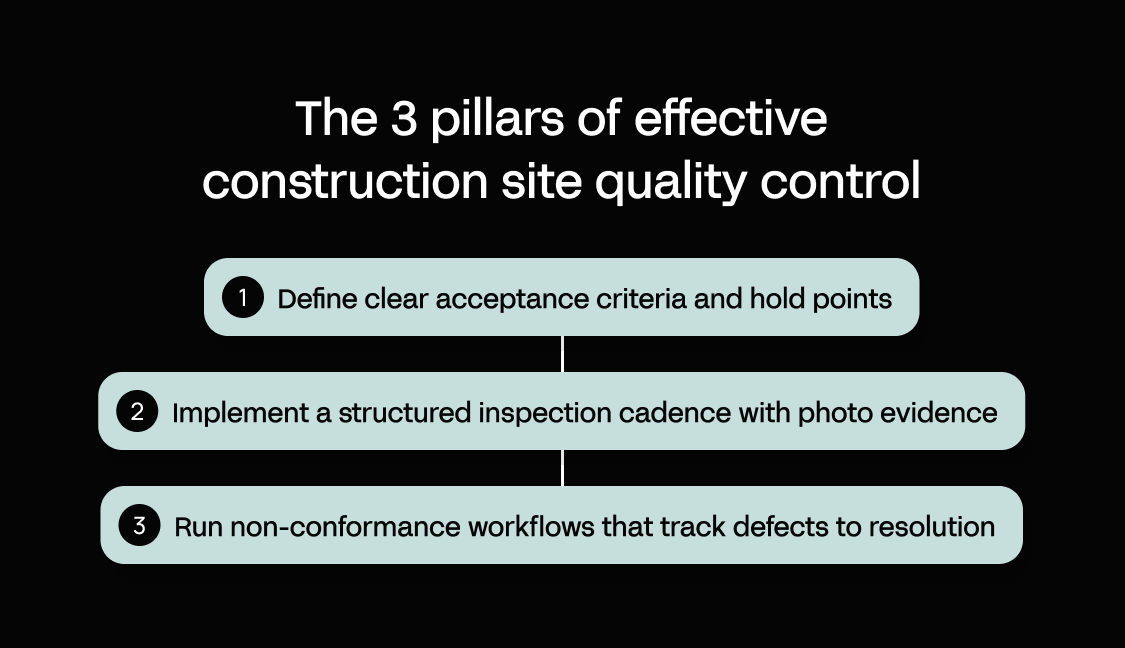
Daily QC routine
- Start with a morning toolbox talk on the day's critical construction activities and quality hold points, and confirm materials match approved submittals with valid test certificates.
- Run first-work inspections during the day (the first pour, the first weld, the first panel) to confirm the crew meets acceptance criteria before scaling up.
- Close the day by walking completed work, photographing progress and deviations, and logging inspections and NCRs in the site diary. Many teams pair this walk with safety inspections so a single pass covers both safety and quality standards.
Weekly QC verification
- Review every NCR raised that week: status (open or closed), corrective actions taken, and recurring defect patterns by trade or area.
- Meet trade foremen and the quality control manager to review upcoming hold points, material deliveries, and any spec clarifications needed.
- Audit documentation completeness: signed ITPs, geotagged photos in storage, filed material testing results, and a current punch list.
Phase hold points
Hold points are critical stages where work cannot proceed until an inspection is completed and signed off. Common examples include pre-pour inspections for concrete, rough-in inspections for mechanical, electrical, and plumbing (MEP), and waterproofing sign-offs before backfill.
Map hold points across the build: compaction tests at earthworks, rebar and formwork inspection at foundations, bolt-up and weld inspection at structure, membrane continuity at the envelope, MEP rough-in, and mock-ups at finishes. These are non-negotiable gates. Skipping them is a leading cause of expensive rework.
Trade-specific quality checkpoints and when to inspect
Every trade has critical checkpoints and common failure modes. Catching them early prevents systemic rework. The tolerances below are typical examples; always work to the project specification and the relevant building codes and industry standards.
Earthworks and foundations
| What To Inspect | Common Defects | Required Evidence |
|---|---|---|
| Excavation depth and width, bearing capacity, compaction (plate load or nuclear density), rebar placement and cover, formwork alignment | Inadequate compaction, rebar spacing errors, formwork movement during pour | Compaction test results, pre-pour photos with measurements, signed ITP |
Typical acceptance criterion: rebar cover of at least 50mm to formwork, confirmed before the pour.
Concrete and structural work
| What To Inspect | Common Defects | Required Evidence |
|---|---|---|
| Mix design approval, slump on delivery, placement without segregation or cold joints, curing, cylinder breaks at 7 and 28 days | Cold joints, inadequate cover, honeycombing, cracking from poor curing | Batch tickets, slump log, cylinder test results, post-pour photos |
Typical slump range for standard pours: 75–125mm.
Structural steel and connections
| What To Inspect | Common Defects | Required Evidence |
|---|---|---|
| Member alignment and plumbness, bolt torque, weld quality (visual plus non-destructive testing (NDT) if specified), base plate grouting | Under-torqued bolts, weld spatter or undercut, misalignment | Bolt torque log, weld maps, alignment survey, connection photos |
Building envelope
| What To Inspect | Common Defects | Required Evidence |
|---|---|---|
| Membrane laps and terminations, flashing continuity, window opening prep, air and water testing | Missed laps, poor flashing at penetrations, weak sealant application | Membrane and flashing photos, blower door or hose test results |
MEP rough-in
| What To Inspect | Common Defects | Required Evidence |
|---|---|---|
| Pipe slope and support, duct sealing, conduit fill, equipment clearances, coordination with structure | Inadequate support, duct leakage, conduit overfill, clashes with structure | Rough-in photos, coordination sign-off, pressure test results |
Finishes and fit-out
| What To Inspect | Common Defects | Required Evidence |
|---|---|---|
| Substrate preparation, mock-ups, floor flatness and wall plumb, protection of completed work | Delamination from poor prep, colour variation, damage from later trades | Mock-up approval photos, flatness survey, protection records |
Commissioning and systems testing
| What To Inspect | Common Defects | Required Evidence |
|---|---|---|
| Functional tests (HVAC balancing, lighting levels, fire alarm), operations and maintenance (O&M) manuals, as-built drawings | Incomplete commissioning, missing documentation, systems below design intent | Commissioning reports, test-and-balance sheets, signed O&M handover |
Documentation standards for construction quality control
Paper inspection sheets, unlabelled phone photos, and verbal approvals create an incomplete record that fails at handover and during claims. Follow clear quality control procedures instead.
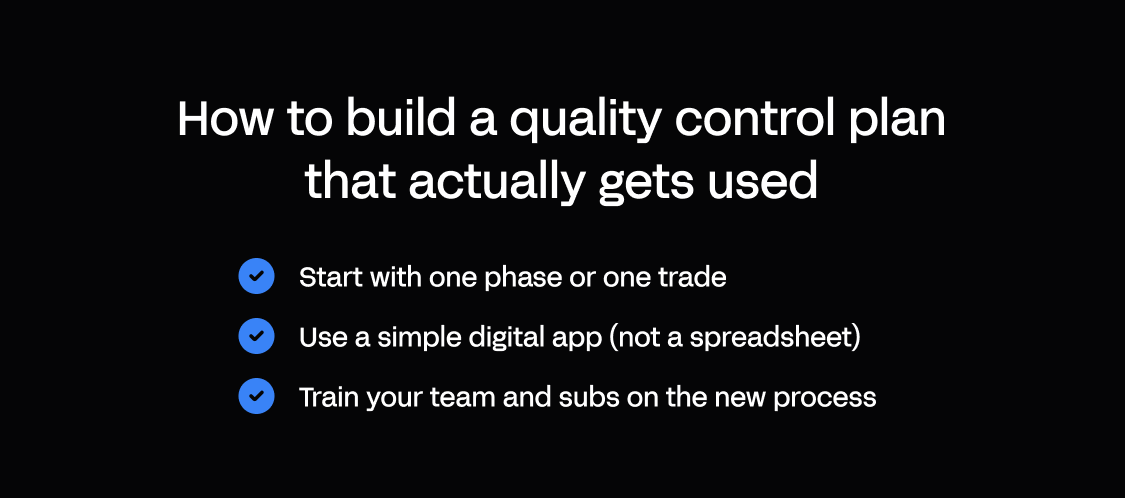
Photo and video evidence requirements
For each inspection, capture a context shot, a close-up of the element, any defect or deviation, and a scale reference such as a tape measure. Label each image with project, phase, area, trade, date, inspector, and the relevant ITP or spec section. Store photos in a central repository, geotagged and linked to the relevant NCR or ITP, not on personal devices.
Inspection test plans and sign-off workflows
An ITP is a pre-agreed construction quality control checklist of inspections, tests, and hold points for a work package, with acceptance criteria and sign-off authority. It typically carries three sign-offs: the trade foreman (self-inspection), the site quality control manager (verification), and sometimes the project owner's representative or a third-party inspector (witness). The workflow runs in sequence: issue the ITP before work starts, complete and document inspections, collect sign-offs, then close and file it.
Non-conformance and corrective action reports
Raise an NCR whenever work fails to meet the spec, even a minor defect corrected on the spot. Each NCR records the defect, location, photo evidence, root cause if known, proposed corrective action, responsibility, and a target close date. A Corrective Action Report (CAR) follows up: document what was done, verify it meets the spec, attach evidence, and close the NCR. Treated well, NCRs become an accountability and learning loop that prevents recurrence.
The quality record at handover
The client expects complete ITPs with sign-offs, closed NCRs, material testing results, commissioning reports, as-built drawings, O&M manuals, and warranty documents. Incomplete records delay final payment, weaken defect-liability claims, and trigger disputes during the defects period. Maintain a live quality binder, digital or physical, throughout the project rather than assembling one in a scramble at the end.
Roles and accountability for site quality
When quality control roles are unclear, inspections get skipped, sign-offs are rubber-stamped, and defects slip through. A simple accountability matrix based on RACI (Responsible, Accountable, Consulted, Informed) fixes that, and naming every party involved in one place removes the ambiguity.
| Role | QC Responsibility |
|---|---|
| Trade foreman / subcontractor | Self-inspection first; confirm work meets the spec before calling for verification |
| Site manager / construction manager | Accountable for the site QC system, daily walkthroughs, and completed ITPs |
| Quality control manager (where separate) | ITP verification, NCR management, audits, quality reporting |
| Client's representative / clerk of works | Witness or approval authority at key hold points |
| Third-party quality control inspectors | Independent verification of structural elements, material testing, and compliance with building codes |
| Project director / contracts manager | Accountable for quality outcomes, NCR escalation, and client reporting |
The workflow is a clear sequence. The trade does the work and self-inspects, site QC verifies and signs the ITP, the client rep witnesses if required, then work proceeds. When a defect is found, an NCR is raised, the trade corrects it, QC re-inspects, and the NCR closes. Sign-offs must happen in the field, at the point of work, not retrospectively in the site office.
How digital tools close the paper-to-evidence gap
Paper inspection sheets get lost, damaged, or never reach the office. Phone photos scatter across devices with no metadata. NCRs sit in spreadsheets that are always out of date. The result is incomplete records, late detection, and weak claims evidence.
The fix is QC tooling that works in the field and captures structured checks, photo evidence, and sign-offs at the point of work, then syncs to a central record. A field-ready digital QC system should do the following:
- Pre-load ITPs and acceptance criteria so inspectors work from the plan, not from memory or paper.
- Attach automatic metadata to every photo (geotag, timestamp, link to the ITP or NCR) so evidence is traceable.
- Allow real-time sign-offs from the foreman, quality control manager, and client rep, with a complete audit trail.
- Run NCR workflows that assign corrective action, set a due date, track status, and close with verification evidence.
- Work on mobile in the field and sync to a central record, so QC does not depend on getting back to the site office.
- Give visibility across multiple projects, so quality performance and NCR ageing can be compared by site, trade, and region.
- Apply role-based permissions so site teams see their work packages, quality managers see everything, and clients see what they need for approvals.
- Integrate with the project schedule, document control, and the ERP that tracks the cost of rework, so quality feeds cost control rather than sitting beside it.
- Export every ITP, NCR, photo, test result, and sign-off in one step for the client's quality binder.
- Host data in the EU or EEA with recognized compliance. For UK and European firms handling sensitive as-built and claims records, hosting location matters.
Governance matters as much as features. In a production-grade setup, approval and sign-off responsibility sits with a named accountable owner (typically the IT team or IT director), not with an individual developer.
On hosting, Appfarm builds Progressive Web Apps (PWAs), web apps that run in the browser and behave like an installed mobile app. It hosts its service data in EU/EEA data centres (Google Cloud in Belgium) and is ISO 27001 certified, with GDPR compliance for EEA data processing (platform security and compliance). That contrasts with US-hosted platforms that offer EU data residency only as a custom or Enterprise add-on.
The differentiator sits in what happens after the app is built. Your team owns what the QC app does; the managed platform owns keeping it running, covering hosting, security, patching, uptime, and disaster recovery. Raw-code tools hand you an app quickly and a codebase you then have to maintain and secure yourself, with no production governance layer for review, approval, and uptime accountability.
Lightweight tools such as spreadsheets and generic form apps can work for simple projects, but they lack the traceability and integration needed once QC becomes business-critical. Heavyweight construction management software gives useful market context at the other end. As of August 2026, Procore does not publish pricing publicly and quotes against annual construction volume, with unlimited users included. Autodesk Build, renamed Forma Build in 2026, uses per-user subscription pricing: about $117 per user per month billed annually, with unlimited-user pricing available by custom quote, according to SoftwareConnect. Both are comprehensive, and both can be a larger commitment than a mid-market firm needs for governed QC.
The middle ground is a platform that delivers production-grade, EU-hosted QC (structured inspections, evidence capture, NCR workflows, role-based governance, and a managed platform that keeps the app running) without becoming a software company. Skanska took this route by working with Godig, an external Appfarm implementation partner and consultancy, to switch its tunnel-building team from Power Apps to Appfarm and win an innovation award for the result (case study).
Common quality control mistakes on construction sites
Even with a strong QC plan, five mistakes derail quality on most sites. Recognising them early is half the fix.
Mistake 1: skipping first-work inspections
The crew starts a new construction activity and scales to full production before the first work is approved. If the first work is wrong, the whole package is wrong, and rework becomes systemic. Always inspect and approve the first instance of any new work type, and build that check into the ITP as a mandatory hold point.
Mistake 2: raising NCRs but never closing them
NCRs get raised and corrective actions agreed, but no one verifies the fix or formally closes the report. The record then shows open defects at handover, so the client withholds retention and disputes follow. Assign every NCR to a named person with a close date, track ageing weekly, and require photo evidence before closing.
Mistake 3: treating QC as a site-office task
Inspections get recorded on paper in the field, then transcribed later in the office, or not at all. Evidence is lost and timestamps drift, leaving an incomplete record. Move QC to the point of work with mobile tools that capture inspections, photos, and sign-offs in real time.
Mistake 4: no clear accountability
"Every construction team member is responsible for quality" means no one is accountable when defects slip through, which breeds finger-pointing and repeat defects. Define clear RACI quality control roles for inspection, verification, approval, and corrective action. Make project quality KPIs such as NCR ageing, rework cost, and inspection pass rate visible to project managers and project leadership.
Mistake 5: ignoring subcontractor QC
The main contractor assumes subs will self-manage quality, with no structured handover or joint inspections. Interface defects and boundary rework follow, and claims against subs are hard to evidence. Require subs to follow the same ITP and NCR process, run joint inspections at interfaces, and build subcontractor quality performance into the monthly valuation.
Conclusion: from paper clipboards to a complete quality record
Most construction sites still rely on paper inspection sheets and scattered phone photos. Defects surface late, rework eats margin, and the as-built quality record arrives incomplete.
Ensuring quality control on a construction site means structured daily and weekly routines, trade-specific inspection checkpoints, real-time photo evidence and sign-offs, clear accountability, and a system that captures it all at the point of work. That is what effective quality control looks like in practice.
Teams that move from paper to governed digital QC catch defects earlier and build a complete record that survives handover and claims. The cost savings come from defects caught at the point of work rather than at handover, which protects both margin and client satisfaction. Site managers get their time back for coordination and delivery instead of chasing missing paperwork.
If your site team is ready to replace paper clipboards with a digital QC system that works in the field and scales with the business, Appfarm for construction teams shows how mid-market firms build governed, EU-hosted mobile inspection workflows without becoming a software company.
Key takeaways
- Quality control on a construction site is a daily field discipline, not an end-of-phase paperwork exercise.
- Define acceptance criteria and quality requirements up front, inspect at hold points, and capture evidence at the point of work.
- Assign clear RACI accountability and track NCRs to closure every week.
- Move from paper and scattered photos to a governed digital quality record that survives handover and claims.
- A field-ready digital QC system should be mobile, integrated, role-governed, and, for UK and EU firms, EU-hosted and compliant.
Frequently Asked Questions
How do you ensure quality control on a construction project?
Define acceptance criteria before work starts, inspect at hold points rather than only at the end, capture photo evidence and sign-offs at the point of work, raise NCRs immediately when work departs from the project's design specifications, and keep a complete digital quality record. Daily walkthroughs and weekly NCR reviews keep the system working.
What are the 5 steps of quality control?
The five steps are: define quality standards and acceptance criteria in the spec and ITP; inspect work in progress at planned hold points; document evidence such as photos, tests, and measurements; raise NCRs and implement corrective actions when work fails the spec; and verify corrections and close NCRs with sign-off. The cycle repeats throughout the project.
How to ensure quality control?
Move from reactive end-of-phase inspections to structured daily and weekly routines: first-work inspections, in-progress checks at hold points, real-time photo documentation, clear accountability for who inspects and who approves, and NCR workflows that track defects to closure. Field-ready digital tools close the paper-to-evidence gap.
How to monitor construction site quality?
Monitor site quality through daily visual walkthroughs, weekly NCR ageing reviews, inspection pass-rate tracking, and phase-gate hold-point sign-offs. Use a digital QC system to track ITPs, NCRs, and photo evidence in real time, and review quality KPIs such as rework cost and defect density by trade in weekly coordination meetings.
What is the difference between quality control and quality assurance in construction?
Quality control (QC) is reactive: inspecting work in progress, testing, and correcting defects. Quality assurance (QA) is proactive: planning processes, setting standards, and preventing defects before they occur. On site, QC is the daily inspection and NCR workflow; QA is the ITP, training, and process audits that make QC effective.
What should a construction quality control plan include?
A QC plan should include project-specific acceptance criteria and tolerances, ITPs for each work package, defined hold points and sign-off authority, NCR and CAR workflows, RACI roles and responsibilities, documentation standards for photos and test results, and the quality record structure for handover. It sits inside the wider quality management plan for the project, alongside the quality assurance plan that sets quality objectives and the regulatory requirements the build must satisfy. The plan must be field-executable, not only a compliance document.
How do you make sure a construction project meets client expectations?
Translate the client's quality expectations into written acceptance criteria before work starts, then evidence them as you go. Agree the specified quality standards and tolerances in the ITP, invite the client rep to witness the hold points that matter to them, and share NCR status openly rather than at handover. Construction projects meet client expectations when the quality record is built continuously, not assembled at the end.
More reading
There are no items matching your filters. Please try another filter to view results.
We have a lot of helpful resources. Try another filter or reset the filters to find the resource for you.
Digital transformation without disruption