


Why is enterprise AI adoption so slow?
Tekna, Digital Norway and Orkla Foods on why AI stalls inside large companies. Management that gives instructions without answers, boards that have never discussed it, pilots launched with no definition of success, and whether cost is really the problem.
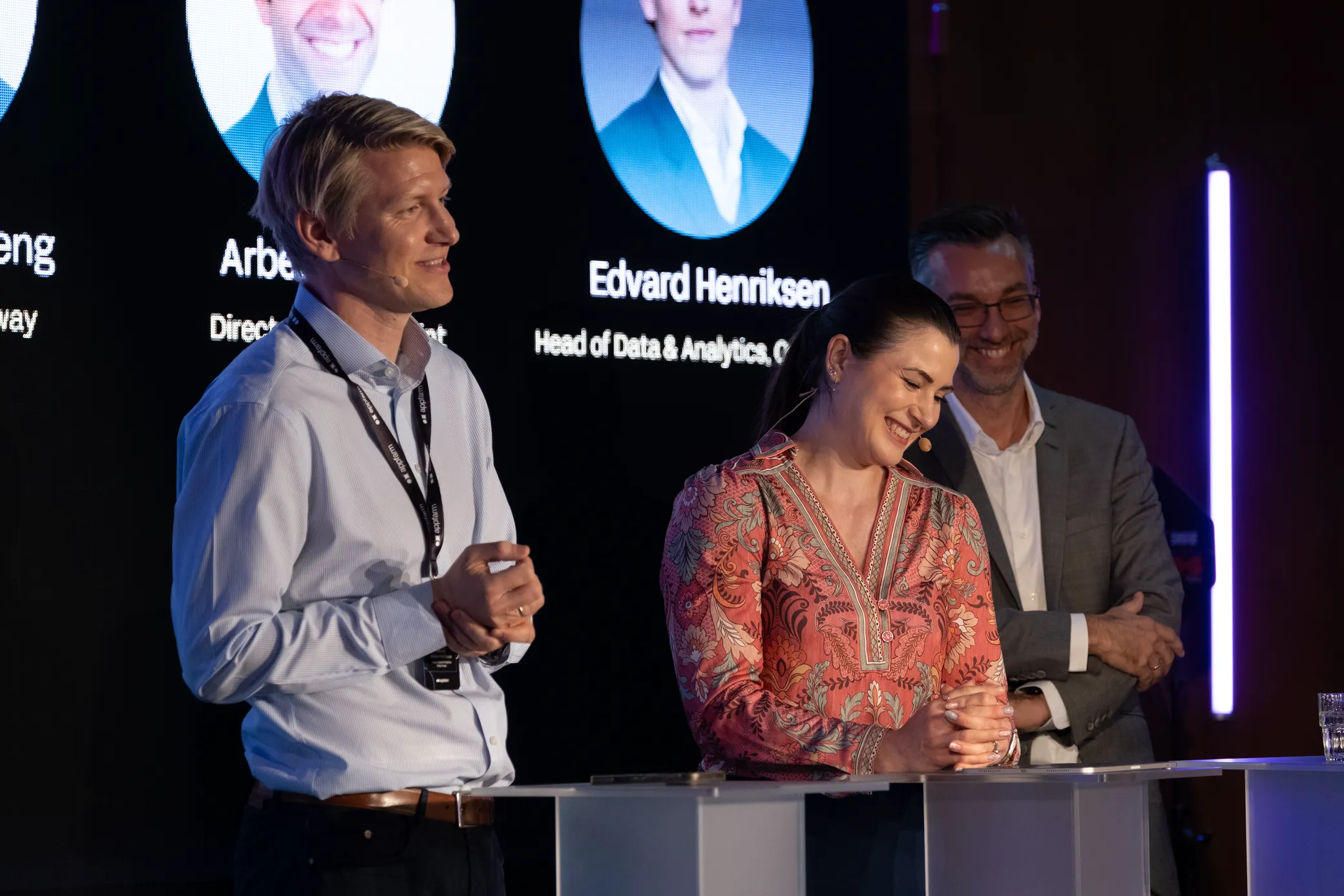
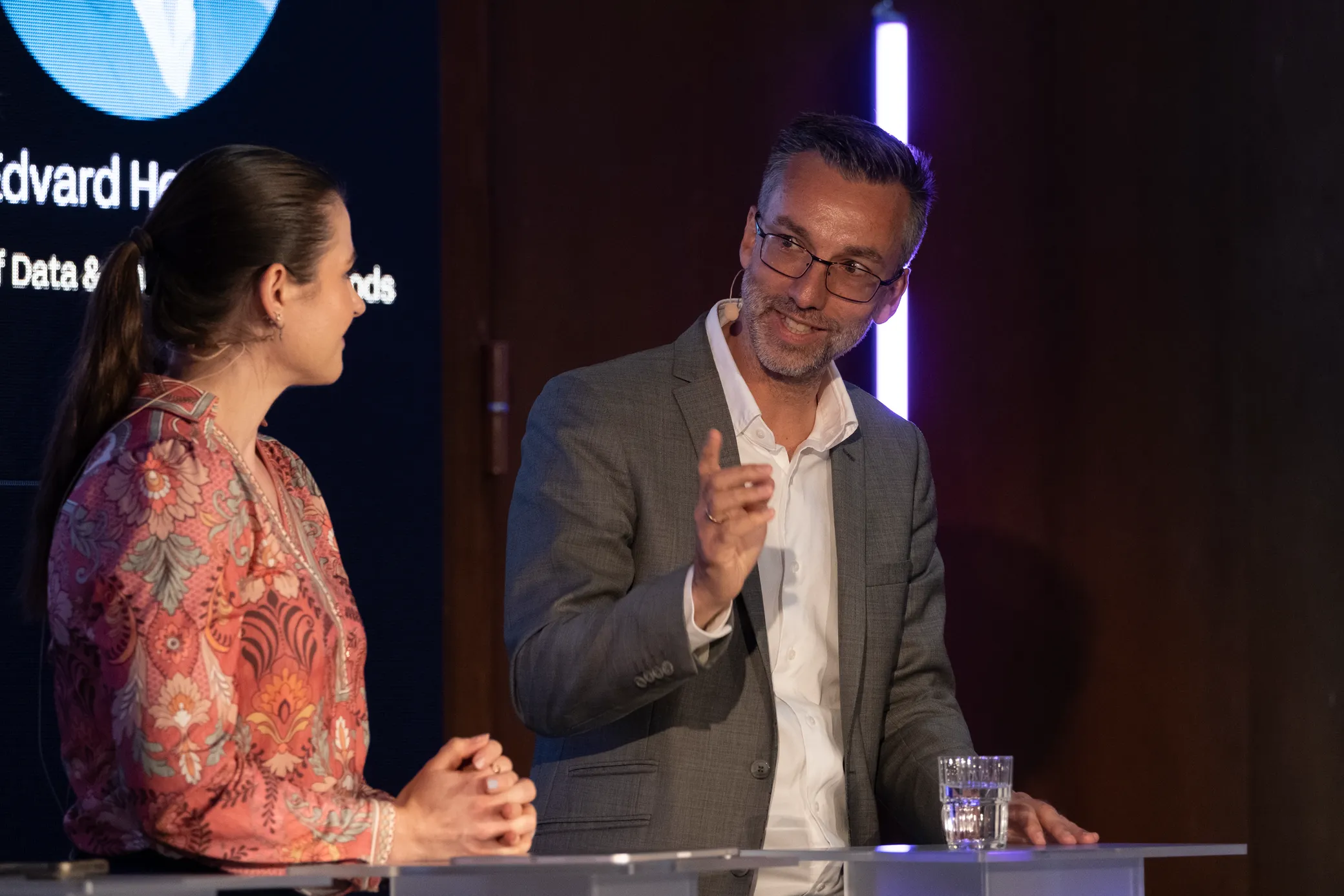
Developalooza 2026, Rebel, Oslo. A panel with Elisabet Haugsbø (President, Tekna), Alexander Haneng (AI expert, Digital Norway) and Edvard Henriksen (Head of data and analytics, Orkla Foods), moderated by Bjørn Bergholt of Avo Consulting.
AI can write, it can produce code, it can automate work and support decisions. Adoption inside large companies is still surprisingly low.
Everyone is using it and nobody is admitting it
Elisabet Haugsbø is president of Tekna, a union with more than 120,000 members, all of them holding a master’s degree or more in a technical subject or something similar. Her answer on what holds employees back was the management layer. Either AI comes from the top or it does not arrive at all, with very little in between, and when it does come from the top it arrives as an instruction without answers. Nobody has said what it is for, who is in charge, or where the lines around the tool are. The licenses get bought, the box gets ticked for the board, and then the board asks why there has been no change in efficiency and whether people are using the tool wrong.
Alexander Haneng of Digital Norway sees the same gap from both sides. He asks executives whether their business uses generative AI and hears about licenses, a prototype and a project, but not really. He asks employees the same question and hears yes, quietly, do not tell the boss, I pay for it on my own credit card, and I save enough time to leave early on Wednesday for the cabin. His question back is who is actually getting the benefit.
Edvard Henriksen runs data and analytics at Orkla Foods, eleven business areas selling branded food across Europe. He agreed that it starts at the top, then qualified it. The demand to use AI more has to arrive with money, investment and a lift in competence. What usually happens instead is that someone has seen a demo or been to a conference and expects a magic button, and the conversation shuts down the moment it turns to data platforms, governance and a three-month timeline.
Half of board members say it has never been on the agenda
Alexander put the problem one level higher again. A report from the Norwegian School of Economics this year interviewed 777 board members holding around 2,000 board seats between them, and asked whether AI had ever been on the agenda of their board in any form. Half said it had not. If it has never been discussed there, the budget, the people and the competence never appear below.
He has made the argument publicly before. When Rune Bjerke ran DNB and had just launched Vipps, he said the company was not a bank any more but a tech company that happened to hold a financial license. Alexander looked at the board, counted how many members had any technology competence, found none, and wrote about it in Dagens Næringsliv. His read is that not much has improved since.
Elisabet’s members are not the obstacle. A Tekna survey two years ago, at the peak of the noise, found very few of them skeptical of the tool itself. What they were asking was how to use it responsibly, how to protect the data and what is safe, and they were looking upwards for the guidelines. The technology on its own solves nothing. It only works inside a system of quality data and governance, which matters more as the data going into these models and agents gets more sensitive.
Pilots die because nobody set a goal
Edvard put a failure of his own next to the criticism. Early in his time at Orkla Foods they ran a marketing initiative with no clearly defined success factor. Nobody knew exactly what they were after or how they would know it had worked, and it died at the pilot stage. The technology is rarely the problem. The harder questions are what happens to the way people work afterwards and how the organization changes to take the benefit.
Elisabet’s counter was that the failure rate itself is fine and companies handle it badly. Ninety percent of startups fail, and the ten percent that survive are what makes the model work. Large companies try something once, watch it fail and stop, which is not even far enough in to reach the ten percent. The rest of the time they do the opposite and keep squeezing something that is not working because somebody likes it. What startups have that enterprises do not is a contained problem and fast checkpoints, so an idea can be killed early and learned from.
Individual adoption is going fine. The organization as a whole is supposed to change, and mostly it has not. Elisabet compared it to the early years of digitalization, where turning a document into a PDF counted as being digital. The Norwegian phrase for it is strøm på papir, electricity on paper.
Norway has not captured the value before
Asked what companies should be most concerned about, Alexander went at it from the national level. His fear is not the risk in the technology but that Norway gets nothing out of it, the way it got nothing out of the last three shifts. There is no Norwegian search engine and no Norwegian social media from the arrival of the internet. The phone in your pocket does not say Nokia or Ericsson any more. There are no Nordic hyperscalers and no AI chip factories here. Europe cannot afford to lose this one too, and capturing the value means understanding what the technology does to each business model, which is a very different thing for an electrician than for a consultancy.
Elisabet declined to follow him into sovereignty, but agreed on the premise underneath it. If companies just use the tool, they end up exactly where they have failed before.
Where to start
Alexander’s answer was to follow the money. Find where the cost is today or where there is more revenue to be had, pick the project with a real return, set a clear goal, put a task force on it with a budget, have them report to the CEO and let them run.
Elisabet was unconvinced by the thirty-day framing. What she would accept in thirty days is a list: can you identify fifty projects worth looking at? That is a reasonable question to answer in a month. A pilot reaching production is not. Her advice on picking the first one was to take something you want to get rid of, a task people hate and spend a lot of time on, because then the enthusiasm comes free. And not to hand it to the management team, but to whoever is genuinely keen to drive the change.
Edvard had a matching warning. One of his management groups went off and evaluated another AI platform, which in hindsight he thinks was a waste. A group with no time to properly test something came back saying they liked it, and all that would have achieved was another platform and a higher cloud bill. Saying you are an AI first company is easy. Saying you want AI because it will let you do specific things faster, so you can redirect people and change how the work happens, is the version that can be acted on. As head of data and analytics he has to be able to answer what it does for the business, which at Orkla Foods means how it helps sell more ketchup. If you do not know why you are doing it, do not do it.
Whether cost is really the problem
Cost came up from the floor, off the back of the headlines about billion-dollar token bills. The attendee’s case was for starting with open source: Norwegian language models are much better than people assume and free compared to the commercial ones, and his own setup is a 60,000 kroner gaming PC running open source models, now serving 200 people querying company information at no running cost.
Edvard is watching the other side of that. When Microsoft moved an agent feature to pay-as-you-go pricing, he worked out what it would cost if two thousand employees each burned $500 a month generating presentations, and switched it off. Access now goes to people who can say why they need it.
Alexander disagreed, and thinks AI is cheap rather than expensive. He described a scale-up whose five-person team spends 300,000 kroner a month on tokens and saves the cost of fifteen people. Put the token spend in a spreadsheet on its own and of course it looks like new expenditure, because it is. The number only means something next to the value, which is why a project needs a goal it can be measured against. NRK has been open about the same calculation, redesigning its processes alongside a move to a new headquarters, with some of them expected to need 80% less resource for the same output.
Alexander credited the summary to Elisabet. Technology moves at the speed of technology, which is fast right now. People still move at the pace of people.
Part of our series of recaps from Developalooza 2026. Read the rest of the series, or sign up to our newsletter so you don’t miss an invitation to next year’s edition.
More reading

There are no items matching your filters. Please try another filter to view results.
We have a lot of helpful resources. Try another filter or reset the filters to find the resource for you.
Digital transformation without disruption