


Nav Ringsaker: The platform everyone wanted and nobody thought they could build
Nav Ringsaker was told its platform was too complex and its project too small. Then Oslo halted the collaboration and the project manager left. RingsakerKompasset launched anyway: two connected apps in seven languages, built in days rather than through a procurement process.
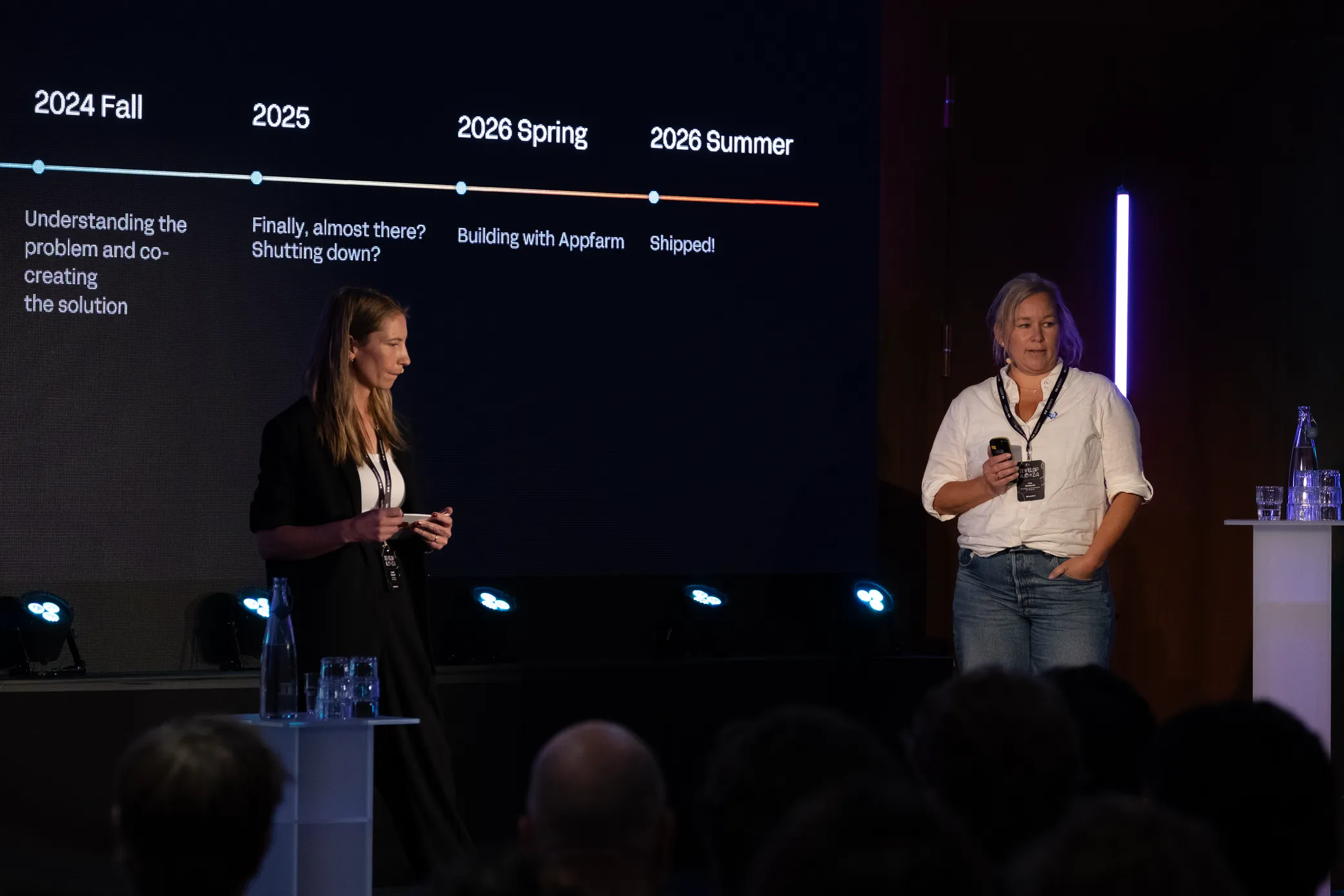
Developalooza 2026, Rebel, Oslo. Customer story from Line Smedsrud and Ingvild Bergseth of Nav Ringsaker, a local office of Norway’s labor and welfare administration.
The session opened with a video. “Språk er nøkkelen for alle,” it began. Language is the key for everyone. You can work. You can thrive in a new country. Then: the first day is difficult for me. Very difficult.
Nav Ringsaker was given a challenge some years ago. Find new ways for public services and civil society to work together to reduce social exclusion. What they expected to be an integration project became a story about co-creation, setbacks, AI, Appfarm, and a platform that almost never happened.
The problem was never a shortage of information
Loneliness reaches well past immigrants and refugees. Around 650,000 people in Norway report being heavily affected by it. So the team started by mapping the problem rather than designing a solution, and one story stayed with them. Someone arrived in late November and thought Norway was dark and cold permanently. It was terrifying. What makes that worse is having nobody to tell you the light comes back.
Finding your way somewhere new takes local knowledge, relationships and an understanding of how ordinary life works, not a list of services. The opportunities already exist in Ringsaker. People cannot find them.
So they ran workshops with refugees, volunteer organizations and public services around the same tables, to build a shared understanding of the problem and design the answer together. After days of talking, everyone agreed on two things. A digital platform was needed. And Nav Ringsaker were not the people to deliver it.
The objections were good ones, about privacy, ownership, scale, security and sustainability, and they came down to a sentence: the solution is too complex and your project is too small. Line Smedsrud’s response was that at Nav they are used to treating resistance as information.
Then it nearly died
By 2024 they understood the problem, the stakeholders and the users, and the objections had led them to a project in Søndre Nordstrand in Oslo working on the same thing. For the first time it felt like it would actually happen.
In spring 2025 Oslo halted all local digital projects. The collaboration fell apart and the project manager left. They had a serious conversation about shutting it down and hoping somebody else would build it one day.
Three things changed that. AI moved what was possible, Line found Ingvild Bergseth, and together they found Appfarm.
Five days instead of a procurement process
They looked at the obvious routes first. Running a procurement process themselves, bringing in local developers, hiring a developer into the project. None of them gave the momentum they needed.
So they gave themselves two days to build a prototype and find out what was possible, which was their introduction to no-code with AI behind it. Security and speed were the two things that mattered, and Appfarm looked like it offered both. They bought AI credits and started building. The two-day experiment ran to five days, by which point they could see both what was possible and what the solution needed to be. When they hit the limits of their own expertise they contacted Appfarm, who Ingvild says understood the vision immediately, and they were in workshops shortly after.
What RingsakerKompasset does
The platform is two connected applications. A partner portal, where organizations publish events and information, and where Nav publishes articles about everyday life in Norway and in Ringsaker: how to apply for kindergarten, why the shops are closed on Sundays, why people wear reflectors when it is dark. And a public app, where residents find all of it, including a section called Guide to Life in Ringsaker.
Everything exists in seven languages, covering the largest refugee groups in Ringsaker. Publishing an event in the portal starts the translation, and it appears in the public app in every language. Switch to Arabic and the content follows.
The feature Ingvild rates above the translation is the speech function, because a lot of people in Ringsaker do not read well in their own language either.
Why the translation had to be automatic
The AI is not there because it is interesting. It is there because the alternative does not scale: every event, every article and every update would need a human translator, which gets expensive and slow and hard to maintain almost immediately.
The split they settled on is that critical information is professionally translated and everything else is machine translated. It is not perfect. It is good enough to make the information reachable.
Without AI the platform would not exist. They would still be discussing budgets, requirements and procurement. Instead they built it, launched it, and are now testing it with real users.
What they would say to anyone sitting on a similar project
They had been treating this as an information problem when it was a connection problem. RingsakerKompasset connects the people who need to be working on loneliness and integration together, and the solution emerged from the community rather than arriving for it.
Asked how it had landed, they said the launch party on the Tuesday produced a few critical voices who have since become their best friends, and a lot of enthusiasm from well beyond the group they built it for. The most common request now is to widen it, particularly to young people, who also struggle to find their way around a complicated society.
Line closed on this. Sometimes the biggest risk is not trying something new. It is doing nothing at all.
Part of our series of recaps from Developalooza 2026. Read the rest of the series, or sign up to our newsletter so you don’t miss an invitation to next year’s edition.
More reading
There are no items matching your filters. Please try another filter to view results.
We have a lot of helpful resources. Try another filter or reset the filters to find the resource for you.
Digital transformation without disruption