


Energima: When build beats buy
Energima is a ventilation company, not a software company, and it is the heaviest user of Appfarm AI in Norway. Ulrik Rørnes and his team built a service portal and a field service app in around ten effective days, with 95 percent of it AI generated.
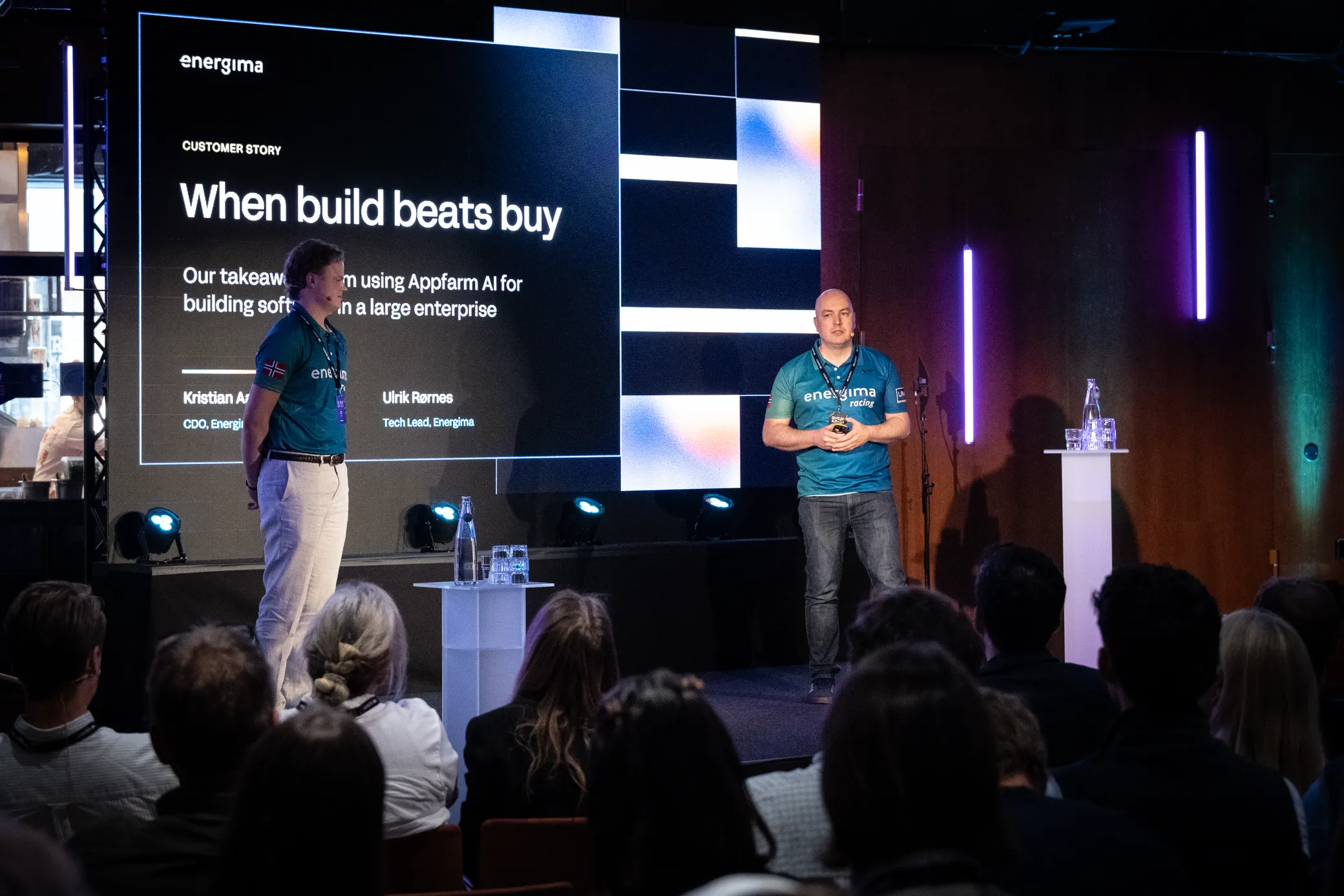
Developalooza 2026, Rebel, Oslo. Customer story from Kristian Aaslund, CDO, and Ulrik Rørnes, Tech lead, at Energima Gruppen.
Energima is not a software company. Its product, as Kristian Aaslund put it, is more or less air. It also needs a great deal of software.
The company works in ventilation and indoor climate, with around 600 employees and annual revenue of roughly 2.2 billion kroner. It has grown over recent years through acquisition and digitalization, and early on it found that off-the-shelf software was not a good fit. That is where Appfarm came in, and it has been a core part of the digital strategy since.
What the operation suite already covered
Energima’s operation suite runs most of the company’s value chain. Proposals, converting them into projects, generating legal documents, pricing and cost, invoicing. Those are a lot of apps, built up over several years.
One part of the chain was missing, and it was the part with the most people in it: the technicians.
What changed after summer
As of September 2026 Energima’s Appfarm AI usage is the second highest of any customer and the highest in Norway. Early on it was testing and experimenting, the kind of use where you are mostly finding out whether something is possible at all. Then after the summer the team found they could build an app that would not have been feasible a year earlier, and went all in.
Speed is not the only return. Kristian’s point was that it changes what you can afford to try. For a feature or a view that a lot of people will use, they can now build several versions, put them against each other and take the best one to production. His conclusion after the first stretch of heavy use was that AI is a superpower in the right hands at the right time.
He was specific about where that superpower sits. On a new app, with a clean sheet and motivated people, you enter it almost immediately, because Appfarm AI is strong at interfaces, views and whole new apps. He expects the advantage to narrow as a solution matures, and said the work now is widening the part of the curve where it still applies. He also noted that his own slide might already be out of date, given what had been announced in the product session that morning.
Two apps for the technicians
Ulrik Rørnes and the IT team built the missing piece over roughly two months: a service portal and a field service app.
In the service portal, a service deal holds everything about the job in one place. Location and map, customer and facility, invoicing details, the technical detail of the visit. Under it sit recurring visits, urgent visits, the equipment to be serviced, checklists tied to each system and to the individual aggregates, documents, and an activity log.
The field service app is where the technician actually works. It opens on their own numbers: visits completed, visits outstanding, offers sent, any outstanding balance, whether they have a service car. Below that are the service deals they are attached to and the jobs they have to do, as a list, a calendar they can filter by month, week or day, and a map. Opening a job and an aggregate gets them to the checklist, and the completed work is documented in the same place as everything else about that deal.
Ten effective days
Ulrik put two numbers on the build. Ninety-five percent of what he demonstrated was built by Appfarm AI, and the team of three spent around ten effective days on it, counting planning and prompting as well as building.
Someone in the audience asked how that 95 percent had been arrived at and what the other 5 percent actually contains. The answer from the stage was that it is nitpicking. A UI component or a piece of logic you are not happy with, where writing the action yourself is simply quicker than asking for it again.
How to get more out of it
Three recommendations came out of the session.
- Let the design agent do the design. If interfaces are not your strength, it will give you versions and ideas you would not have arrived at.
- Write the prompt somewhere else first. Use Claude, Gemini or Appfarm AI's Ask modeto turn a rough intention into a detailed, rigid prompt before sending it to build. The output is noticeably better for it.
- Know what you are doing. Developer experience still counts, because Appfarm AI is a multiplier rather than a replacement.
The part that is still hard
A question from the floor got at the thing none of this solves. If you can build at this speed, how do you handle rolling it out and getting people to use it?
They are about to find out, and this is where AI is not yet a superpower. Adoption will be the most time-consuming part of the work from here, and the most important.
Asked what would extend the phase where AI is doing the heavy lifting, the answer pointed at solutions already in production, where the logic is complex and carries real dependencies, real data and real users. Keeping the speed there means building on top of what already exists, so the AI has the context to work from.
Part of our series of recaps from Developalooza 2026. Read the rest of the series, or sign up to our newsletter so you don’t miss an invitation to next year’s edition.
More reading
There are no items matching your filters. Please try another filter to view results.
We have a lot of helpful resources. Try another filter or reset the filters to find the resource for you.
Digital transformation without disruption