


What you still buy when anyone can build
If anyone can build, what do you still buy? A panel with Asplan Viak, Verdane, Omnium and Kodemaker on where building yourself now works, what owning it costs for years afterwards, and which software people will keep paying for.
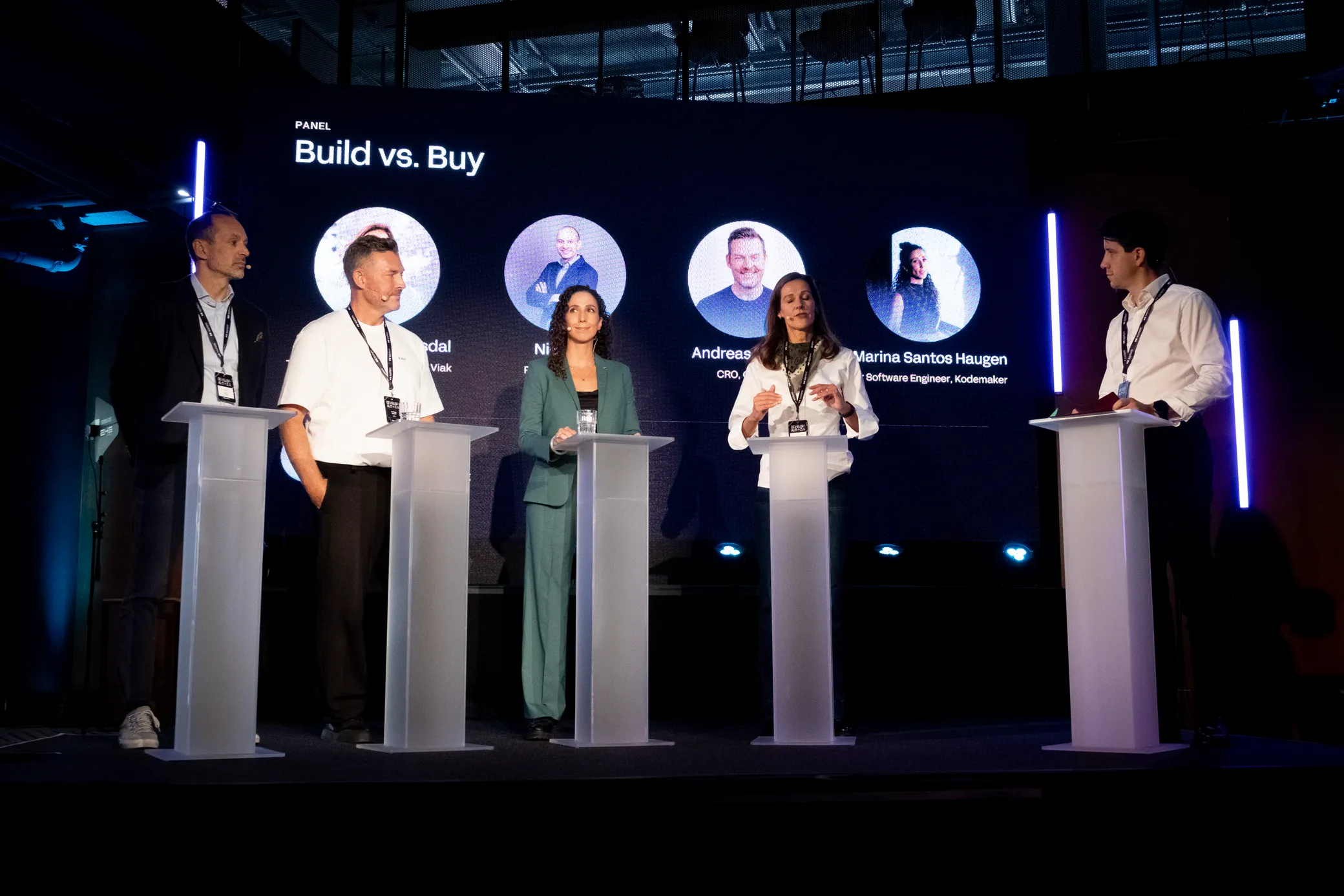
Developalooza 2026, Rebel, Oslo. A panel with Anne Strand-Gjesdal (CTO, Asplan Viak), Nils Vold (partner, Verdane), Andreas Sjölund (CRO, Omnium) and Marina Santos Haugen (senior software engineer, Kodemaker), moderated by Bjørn Bergholt of Avo Consulting.
The morning had been about how much easier it has become to build software. Just because you can build something does not mean you should, so what is still worth buying?
The people closest to the problem are building
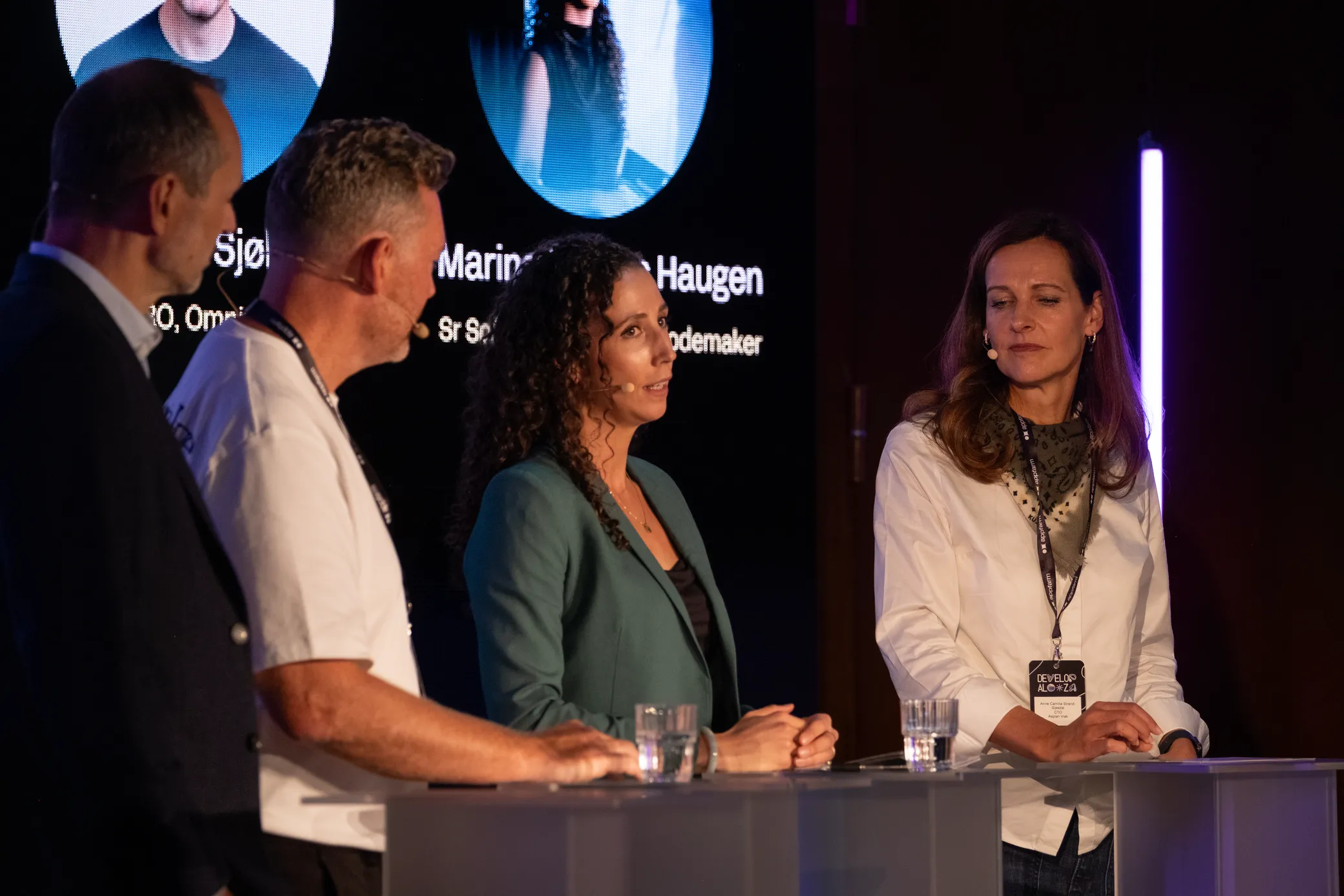
Asplan Viak is an engineering and architecture consultancy with around 1,300 employees. Anne Strand-Gjesdal has wanted an environment with citizen developers for a long time, and her view is that AI finally made it possible. Not because AI writes code faster, but because her consultants, architects and engineers can now have AI write code for them. They sit closest to the problem, so they can take the software to the problem rather than the other way around. In practice that means prototypes to show clients, and plug-ins that tailor the software they already use.
Marina Santos Haugen disagreed with the premise. Building has not moved to the people who understand the problem, because the best developers always had to understand the problem first. What changed is that the product development cycle collapsed. Work that used to pass between three roles in sequence now happens at once, and one person can go from thinking about the problem to designing the solution to writing the code in a single afternoon.
What that one person does not see is the risk. She cited a scan a security firm ran in May across several hundred vibe-coded repositories, which found sensitive data, including personal records, sitting exposed in them.
Nobody can show where the productivity went
Nils Vold invests in tech companies at Verdane, and he has been putting the same three questions to everyone he meets. Are you more efficient with AI? Everyone says yes, hours instead of days. So what do you do with the gain, do you take Fridays off? Nobody does, everybody works more. Does any of it show up as higher revenue or higher EBITDA? The answer is usually zero. He asked the room for examples of real monetization and said he had not seen many. The companies taking money out of this so far are Anthropic and Nvidia.
What it costs to own what you built
Andreas Sjölund co-founded the workforce management platform Quinex before any of this existed, and is now CRO at Omnium. He does not think AI kills SaaS. At Omnium it lets a smaller team build more, which brings the cost down, which means the product can be sold cheaper. What people miss is everything after the build. You can put something impressive together quickly, but then you have to host it, maintain it and support it. Someone has to be awake at five in the morning when the point of sale will not start and the store opens early, which is the day two problem from the opening keynote.
Kodemaker built their own internal CRM, which Marina would have called a stupid idea before AI given how many already exist. The main functionality took three weeks. Then the maintenance started. You need one developer who owns it, and the budget for them. AI-generated code also tends toward the most common tech stacks, because that is what the models saw most of, and the most common stacks are the most attacked, so dependencies have to be kept current. She has Dependabot opening pull requests every second week for her to review. The other thing that breaks is performance: code that is fine with ten users falls over when real traffic arrives.
Asplan Viak runs a vibe coding pilot with 20 or 30 projects in it, small tools and plug-ins, inside guardrails, with the IT department carrying the security and the maintenance. Anne does not expect most of them to last long.
Horizontal tools go first
What is still worth buying comes down to complexity. Consumer and micro-business software is fairly easy to replicate, and the higher you go toward enterprise mission-critical systems the harder it gets. A large ERP carries years of domain knowledge, integrations that keep changing, regulations that keep changing and a long tail of customer requirements.
Marina split it by shape instead. Horizontal point tools solve one problem for many people, a Trello or a generic CRM, and the data model is easy enough to copy that you can rebuild the thing in a week. Vertical software solves a problem for one industry, with the domain model built into it. Ten years of fixing issues is in there. Build it yourself and you will hit those same issues, one at a time, with nobody ahead of you.
Omnium started as an order management system, close to an ERP, then added e-commerce on top, then a point of sale that connects to hardware. Each step made it harder to replace. Compliance, hardware and proximity to the customer are what Andreas thinks companies keep buying. Anne agreed that business critical systems will still be bought, and added that the most valuable companies in the world are tech companies, so they need to be challenged. That is the part she likes about vibe coding: modules and small fixes built in-house and added to software the company already owns.
What you are buying when an agent is the user
If people send an agent instead of opening the product, what they are paying for changes. Marina’s answer was the data model, the uptime guarantees and someone else carrying the risk. She pointed at Oda, a Norwegian online supermarket, which released an MCP server so you can shop in a chat interface, and an agent in the app that fills the weekly basket. Users open the app less and spend more. Getting there meant fixing their data structure, because they had several different ways of tagging the same product.
Anne is skeptical about agents inside core systems. Her colleagues use them to find things without going into the software, but they have to apply their own knowledge to check the answer is right. Nils said Verdane uses agents already, while warning about the bragging around them. Someone says they have thirty agents running; go one level down and ask whether any of it is part of a business process. He also offered a prediction he got wrong during the move to cloud, when he thought nobody would use a PC again because everything would go to phones and tablets. It did not happen, because you still need the input and the output. So he would not predict what AI does to the interface, except that he does not think it disappears.
Is SaaS dead?
Some SaaS companies are in real trouble. Nils once invested in a dashboard product that sat on top of HubSpot, and that is something you can now build for yourself. Marina brought numbers. The SaaS market was around $320 billion in 2025 and is forecast to reach $500 billion by 2028, so the spend is going up. What changes is the mix. Roughly a third may already be gone, and that third is the horizontal tools people now build for themselves. What she expects to move next is the pricing, because charging per seat stops making sense once the thing logging in is an agent.
One attendee had spent two days playing golf while an agent worked through a customer project, and asked where that ends. Nils said he did not know, and that software is still massively underused across public sector and healthcare, and every disruption so far, from the internet to mobile to cloud, has increased software investment rather than reduced it. Anne’s answer was that software now has a much shorter lifespan, so you build it, throw it away and build the next one. Marina’s was that agents have barely started. Over the summer she built a project manager agent for the Kodemaker CRM that watches labels on GitHub issues: label one and it writes a spec from her template, review the spec and label it again and the agent implements it. Less a tool, she said, than a coworker.
Part of our series of recaps from Developalooza 2026. Read the rest of the series, or sign up to our newsletter so you don’t miss an invitation to next year’s edition.
More reading
There are no items matching your filters. Please try another filter to view results.
We have a lot of helpful resources. Try another filter or reset the filters to find the resource for you.
Digital transformation without disruption